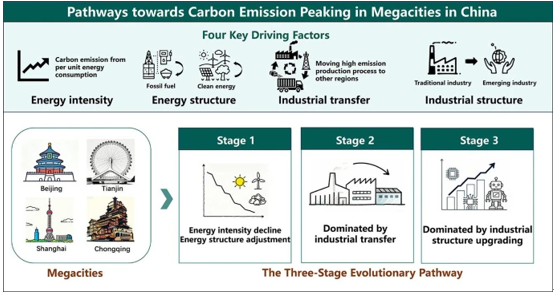
FAYETTEVILLE, GA, UNITED STATES, July 7, 2026 /EINPresswire.com/ — As cities become decisive arenas for climate action, carbon emission peaking is no longer only a national target; it is also an urban transition challenge. A new study maps how four Chinese megacities—Beijing, Tianjin, Shanghai, and Chongqing—moved toward carbon emission peaking between 2007 and 2017. The research shows that cities do not peak emissions through one simple measure. Instead, they move through a staged pathway shaped by energy efficiency, cleaner energy use, industrial transfer, and industrial upgrading. By linking emission cuts with economic benefits and employment outcomes, the study offers a practical route for large cities seeking climate progress without losing development momentum.
China’s carbon peaking and carbon neutrality goals have put cities under growing pressure to control emissions while sustaining growth. Megacities are especially important because they concentrate population, infrastructure, industry, services, and consumption, and their supply chains extend far beyond city boundaries. Conventional city-level carbon accounting can show whether emissions rise or fall, but it may miss the forces behind the change, especially when industrial relocation shifts emissions to other regions. Policymakers also need to know when efficiency gains are enough, when energy systems must change, and when industrial restructuring becomes unavoidable. Because of these challenges, in-depth research is needed to clarify the staged mechanisms and policy pathways through which megacities can achieve carbon emission peaking.
Researchers from the School of Environment, Beijing Normal University published (DOI: 10.1007/s11783-026-2218-5) the study on April 20, 2026, in ENGINEERING Environment. The article, titled “Pathways towards carbon emission peaking in megacities in China,” examined Beijing, Tianjin, Shanghai, and Chongqing from 2007 to 2017. Using a multi-regional input-output (MRIO) framework and structural decomposition analysis (SDA), the team quantified how energy intensity, energy structure, interregional industrial transfer, and industrial upgrading contributed to changing urban carbon dioxide (CO2) emissions, and how these forces differed across cities and stages.
The study identifies a three-stage pathway for carbon emission peaking in Chinese megacities. In the early stage, the strongest driver is reduced energy intensity, meaning cities generate more output with less energy consumption. From 2012 to 2017, lower energy intensity cut emissions by 35.2 million tonnes (Mt) in Beijing, 89.4 Mt in Tianjin, 97.5 Mt in Shanghai, and 72.9 Mt in Chongqing. As the effect of efficiency gains weakened, cleaner energy became more important, further reducing emissions by 8.2 Mt in Beijing, 5.3 Mt in Tianjin, and 2.9 Mt in Chongqing. The second stage centers on industrial transfer. The study finds three patterns: emissions-only shifts, simultaneous shifts of emissions and economic benefits, and limited outsourcing. This means relocation can lower one city’s emissions inventory without solving the broader carbon problem. The third stage depends on structural upgrading, especially the move from traditional manufacturing toward strategic emerging manufacturing and services. This shift can reduce emissions while improving economic returns and job opportunities, making industrial renewal a core part of long-term urban decarbonization.
The authors said the study reframes carbon emission peaking as a sequence of choices rather than a single milestone. They said early progress often comes from improving efficiency, but cities cannot rely on efficiency gains forever. Once the easiest reductions are exhausted, governments need cleaner energy systems, smarter regional coordination, and deeper industrial upgrading. They said carbon governance should follow the full industrial chain, because moving high-emission activities away from one city may leave the wider carbon challenge unresolved and weaken the credibility of local climate progress.
The findings can help city planners, policymakers, and regional development agencies match carbon-peaking strategies to each city’s transition stage. Cities still dominated by high energy intensity may gain most from efficiency measures. Cities approaching an efficiency plateau may need faster energy-structure adjustment and cleaner power supply. Industrial hubs should pair relocation with industrial upgrading, employment planning, and regional carbon accounting. More broadly, the framework provides a transferable way to identify where emissions are being reduced, where they are being displaced, and how megacities can pursue carbon emission peaking while protecting economic resilience, jobs, and public confidence in low-carbon transition.
References
DOI
10.1007/s11783-026-2218-5
Original Source URL
https://doi.org/10.1007/s11783-026-2218-5
Funding Information
National Natural Science Foundation of China (No. 72174026)
Lucy Wang
BioDesign Research
email us here
Legal Disclaimer:
EIN Presswire provides this news content “as is” without warranty of any kind. We do not accept any responsibility or liability
for the accuracy, content, images, videos, licenses, completeness, legality, or reliability of the information contained in this
article. If you have any complaints or copyright issues related to this article, kindly contact the author above.

Media gallery