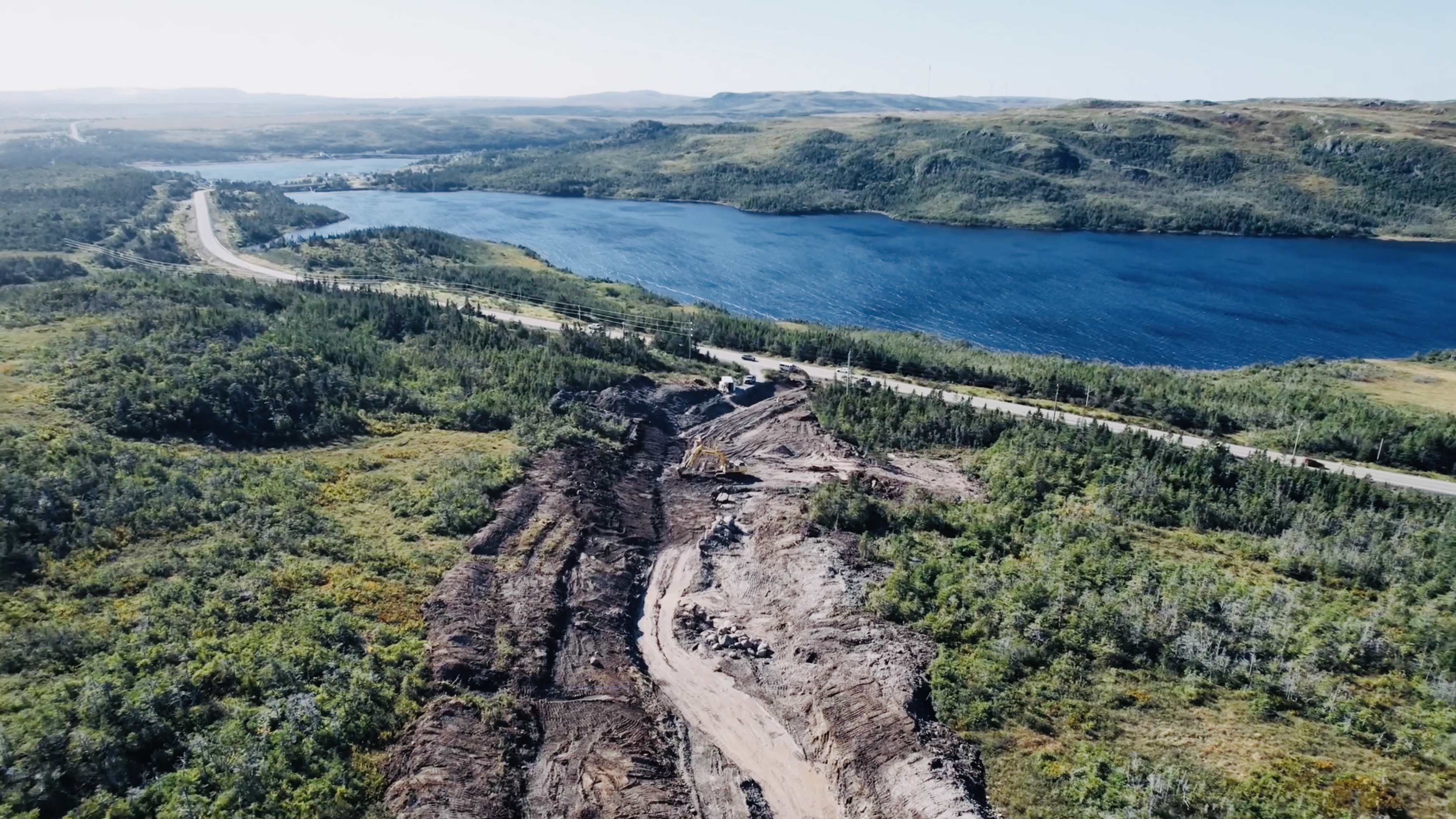
Phase 2 begins at Canada’s largest spaceport, with new road and pad construction at SLC-01 to support medium and light lift vehicles, ahead of NET 2028 launch.
ST. LAWRENCE, NEWFOUNDLAND & LABRADOR, CANADA, October 15, 2026 /EINPresswire.com/ — NordSpace Corp., Canada’s only vertically integrated space missions company, entered Phase 2 construction at the Atlantic Spaceport Complex (ASX) SLC-01 (Space Launch Complex 01), the next step toward Canada’s first sovereign orbital launch. Phase 2 opens with a six-kilometre launch access road, engineered specifically to carry NordSpace’s Tundra light-lift vehicle and the Tempest medium-lift vehicle to the pad, while Phase 1 started in 2024 culminating with landmark environmental approvals, crown lands grants, construction of Pad 2A at SLC-02, initial flight tests, and more. Phase 2 is targeted for completion by Spring 2027, at which point installation will begin of core systems that bring the spaceport online: two orbital launch pads, mission control, propellant storage, launch platforms and towers, ground stations for rocket and satellite communications, vehicle integration hangars, ground support equipment, utilities including power and water, and the first elements of a visitor centre. Together, these milestones bring the Atlantic Spaceport Complex on schedule to support made-in-Canada orbital launch NET 2028, in alignment with the Department of National Defence’s Launch the North timeline.
Phase 2 is a critical piece of a vision that is now being executed in parallel across every layer of NordSpace’s integrated program. The company’s first satellite, Terra Nova, is operating in orbit as of earlier this month, where it continues to meet all mission objectives testing common hardware and operations at TRL-9 across launch and space systems at the company, and has made NordSpace the first Canadian launch company operating its own hardware in space. The Taiga suborbital launch vehicle is awaiting its first flight pending final regulatory approvals. At Rocket Factory 1 (RF-1) in Markham, the Tundra orbital launch vehicle is making rapid progress leveraging advanced manufacturing in metal additive and automated composites, and at the Atlantic Spaceport Complex in St. Lawrence, the roads, pads, and systems that will host Canada’s first sovereign orbital launches are now being physically built. Each of these milestones is in service of the same commitment for NordSpace: launching Canadian rockets, carrying Canadian payloads, from Canadian soil.
Phase 2 follows the recent $10 million combined investment in the Atlantic Spaceport Complex, which brought together $1 million from the Government of Canada through the Atlantic Canada Opportunities Agency’s Regional Economic Growth through Innovation program, $4 million from the Government of Newfoundland and Labrador, and $5 million in NordSpace private capital. That capital is now being deployed, delivered in significant part through NordSpace’s partnerships with local contractors and suppliers from across the Burin Peninsula.
The Atlantic Spaceport Complex is the largest and most capable spaceport in Canada. It offers the widest range of launch inclinations available in the country, the largest safety distances of any Canadian spaceport (with room to extend substantially as cadence and vehicle size grow), and the highest approved launch cadence anywhere in Canada. NordSpace owns and operates the spaceport itself, which gives the company full autonomy over its launch site, regulatory posture, and operational tempo. This control and autonomy is critical to support NordSpace’s plans for a high cadence of launches and constellation missions, both of its own constellations and for third-parties.
“NordSpace is working tirelessly to build a company that is sovereign in itself, so that it can in turn power a sovereign Canada,” said Rahul Goel, Founder and CEO of NordSpace. “We are going to great lengths to ensure that not a single stone is left unturned or risk not mitigated, and that Canada ends up with a real sovereign launch capability that is commercially viable, technologically relevant, and operationally scalable. The Atlantic Spaceport Complex is a cornerstone of that capability, and Phase 2 is where the vision takes physical shape at St. Lawrence. Combined with Terra Nova now operating in orbit, Taiga nearing its first flight, and the regulatory work we are advancing alongside Transport Canada, we are putting in place every ingredient of a Canadian space economy where Canadian rockets launch Canadian payloads from Canadian soil.”
NordSpace is working closely with Transport Canada on launch approvals and authorizations under Canada’s new Commercial Space Launch Act and the associated regulatory framework, with further announcements on this front expected in the near term. The regulatory pathway is being advanced in step with the physical build of ASX, so that the spaceport comes online as a fully licensed and operational Canadian launch site.
Phase 2 also incorporates lessons from Terra Nova’s successful mission to orbit. The avionics, mission operations, and payload integration experience gained through Terra Nova, including the hands-on integration of a Canadian-built spacecraft with a launch vehicle at the pad in Vandenberg, is informing the design of ASX’s satellite integration facility, so that the facility supporting NordSpace and future customer payloads reflects direct launch-customer experience from the outset.
As SLC-01 is prepared for Canada’s first sovereign light- and medium-lift orbital launches, SLC-02 will continue to host NordSpace’s Taiga program. Following Taiga’s first launch, pending final regulatory approval, the Taiga program will evolve into VERTEX (Vehicle for Experimental Rocket Testing and EXploration), a NordSpace program that will allow government, academia, and industry to procure sovereign Canadian suborbital flights at a high cadence. VERTEX will serve as a dedicated platform for retiring risk ahead of orbital launch procurement and operations, giving Canadian and allied customers a domestic flight-test option for payloads, subsystems, and technologies that today have no sovereign Canadian suborbital path to space. Alongside its VERTEX commercial role, continued Taiga activity at SLC-02 will build operational cadence and discipline, hardening the technologies, regulatory pathways, operational procedures, and quality controls that NordSpace will carry into orbital flight at scale beyond the first orbital mission.
Additional ASX infrastructure is also planned to build operational currency ahead of first orbital launch. NordSpace intends to establish vertically integrated test complexes, Test Complex 1 (TC-01) and Test Complex 2 (TC-02), at the spaceport, supporting full-stack vehicle testing at the same site, and on the same ground, from which the vehicles will ultimately fly. This “test where you fly” philosophy gives NordSpace’s launch, operations, and range teams meaningful hands-on time with the exact infrastructure and procedures of operational flight before the first launch campaign. NordSpace will also build a ground station at ASX as part of the company’s own NordSpace ground station network, which will begin standing up in 2027 with initial Canadian nodes at ASX, in the Arctic, and in southern Ontario at Rocket Factory 1 in Markham. Further strategic international nodes will follow.
The Atlantic Spaceport Complex is designed first and foremost to prioritize sovereign Canadian launch for NordSpace, and the scale, inclination coverage, and safety corridors of Canada’s largest spaceport make it well suited to host additional launch partners alongside NordSpace’s own flights. NordSpace is actively engaged with several launch companies looking to use ASX for their own operations. The operational model is deliberately not one of gatekeeping. NordSpace assists partner operators where help is needed, while carefully managing the number of simultaneous users so multiple companies can conduct campaigns without triggering range conflicts. Further detail on partner launch customers for both hypersonic test campaigns and orbital missions will be shared in the near future.
NordSpace will also share further announcements in the coming weeks and months on significant investments and contracts across its launch, spacecraft, propulsion, and spaceport programs, as the company continues to scale the capability base required to deliver sovereign Canadian launch at commercial pace.
About NordSpace
NordSpace Corp. is Canada’s only vertically integrated space missions company, fully Canadian-owned and dedicated to launching Canadian vehicles, from Canadian soil, carrying Canadian payloads. The company develops and operates launch vehicles, including the Taiga suborbital pathfinder, the Tundra light-lift vehicle, and the Tempest medium-lift launcher, powered by the patent-pending Hadfield-150 engine, Canada’s first orbital-class liquid rocket engine. NordSpace designs and builds its own spacecraft systems in-house at its Space Systems Lab in Markham, Ontario, and operates the Atlantic Spaceport Complex in St. Lawrence, Newfoundland and Labrador, with propulsion test operations at Area 66 in Eastern Ontario, headquarters and manufacturing at Rocket Factory 1 in Markham, Ontario, and a policy and government relations office in Ottawa.
Jennifer Gawor
NordSpace Corp.
contact@nordspace.com
Visit us on social media:
LinkedIn
Instagram
YouTube
X
NordSpace – Atlantic Spaceport Complex Enters Phase 2, Canada’s Largest Spaceport
Legal Disclaimer:
EIN Presswire provides this news content “as is” without warranty of any kind. We do not accept any responsibility or liability
for the accuracy, content, images, videos, licenses, completeness, legality, or reliability of the information contained in this
article. If you have any complaints or copyright issues related to this article, kindly contact the author above.

Media gallery