
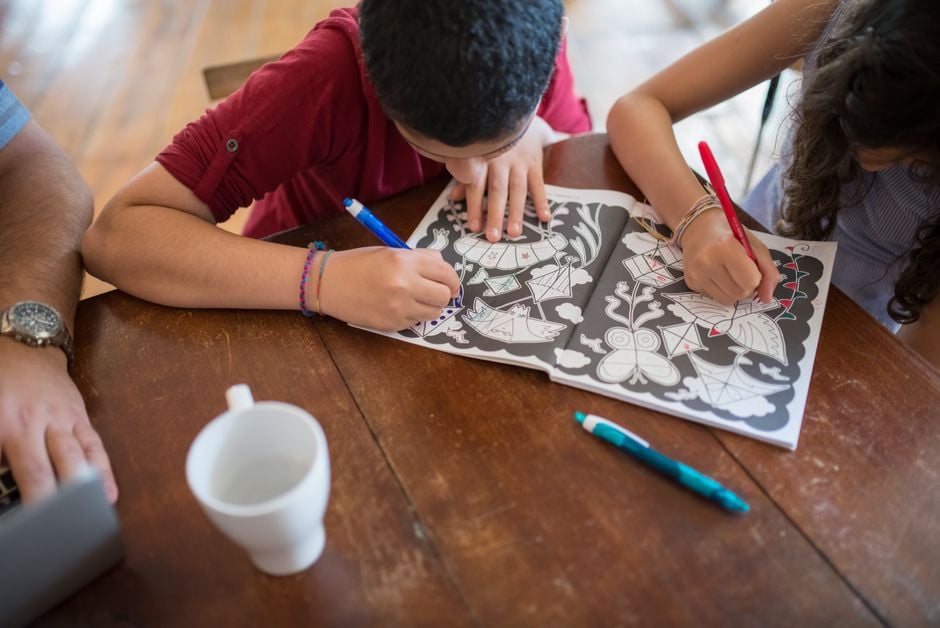
- Activity books aren’t just entertainment — they build real cognitive skills, fine motor strength, and focused attention that screens simply can’t replicate.
- The science is clear: hands-on, tactile learning during early childhood creates neural pathways linked to memory, executive function, and academic readiness.
- Every finished page is a confidence boost — small wins add up to genuine self-esteem and a growth mindset that carries into school and beyond.
- Choosing the right book matters more than most parents realize — age-match, activity variety, and progressive difficulty are what separate a great pick from one that ends up under the couch.
There’s a moment most parents recognize instantly: a child hunched over a page, pencil in hand, completely absorbed. No notifications. No autoplay. Just focus. That moment isn’t just peaceful — it’s productive in ways that reach deep into how young brains develop.
Yes — and the Developmental Science Backs It Up
With so many products claiming to be “educational,” it’s reasonable to wonder whether activity books deliver real value or just keep kids quiet for a while. The answer, backed by child development research, is that they deliver both — and then some.
The early years of childhood represent a critical window when the brain forms neural pathways at a rapid rate. Children who regularly engage with interactive, tactile materials show increased activity in brain regions associated with learning, memory, and executive function.
Activity books sit squarely in that sweet spot. They transform learning into play, layering cognitive challenges, creative expression, and physical skill-building into a single, screen-free experience. Research published on PubMed Central found that the majority of preschool children engage daily in reading (85%) and physical activity (75%) — even alongside reported screen time — suggesting children are naturally drawn to hands-on engagement when given the opportunity.
They Build the Brain Skills Screens Simply Can’t
Screens are stimulating — but stimulation isn’t the same as development. Passive digital content moves fast, rewards attention with novelty, and rarely asks a child to sit with a problem long enough to solve it. Activity books work differently. They require active participation, strategic thinking, and a willingness to try, fail, and try again.
Mazes and Puzzles Develop Real Problem-Solving
Every maze in an activity book is a low-stakes critical thinking exercise. To navigate one, a child must visualize paths ahead, recognize dead ends, backtrack without frustration, and adapt their strategy — all in real time. These aren’t abstract skills. They transfer directly to mathematical reasoning, reading comprehension, and the kind of flexible thinking teachers look for in early learners.
Logic puzzles and matching games build on that foundation. They challenge children to categorize, compare, and draw conclusions — the same cognitive moves that underpin scientific thinking and organized problem-solving later in school. Crucially, this all happens in what experts describe as a “low-pressure environment,” where getting it wrong just means trying a different path.
Pattern and Memory Games Lay Math Foundations
Pattern recognition activities — completing color sequences, identifying shape progressions, predicting what comes next — are doing foundational math work long before a child ever sees a number line. These exercises develop the logical thinking that underpins algebra and advanced number concepts, and they do it through play.
Memory games add another layer. Working memory — the ability to hold information in mind while actively using it — is one of the strongest predictors of academic success. Matching games and sequencing tasks train exactly this skill, building the cognitive stamina kids need for reading, multi-step math problems, and following classroom instructions. When these activities appear consistently throughout an activity book, the cumulative effect on a child’s thinking skills is significant.
Fine Motor Skills Get a Serious Workout
Fine motor development is one of the most concrete, measurable benefits of activity books — and one of the most important. The small muscles in a child’s hands, fingers, and wrists need deliberate, repeated practice to develop the strength and precision required for writing. Activity books provide exactly that practice, built into every page.
1. Tracing Builds Handwriting Muscle Memory
Tracing activities give children structured repetition with writing implements — starting with simple shapes and progressing toward letters and numbers. This isn’t just copying; it’s building the muscle memory that makes handwriting feel natural. The hand-eye coordination developed through tracing directly supports how children form letters when they begin writing independently. Well-designed books start younger children with broad, forgiving shapes, while older children practice finer, more precise strokes.
2. Coloring and Cutting Strengthen Hand-Eye Coordination
Coloring within defined boundaries trains precision and control. Cutting exercises develop bilateral coordination — the ability to use both hands in tandem — which proves useful far beyond art class. Tying shoes, using tools, playing instruments, and eventually typing all draw on this same bilateral skill set. These aren’t side benefits; they’re foundational developmental milestones that activity books help reach in an engaging, low-pressure way.
3. Dot-to-Dot Activities Sharpen Pencil Control
Dot-to-dot puzzles are deceptively effective. On the surface, they look like simple number-sequencing activities — and they are. But the physical act of moving a pencil from dot to dot with accuracy builds pencil grip strength, directional control, and counting fluency simultaneously. It’s a rare activity that blends cognitive and physical skill development so naturally, which is exactly why it appears in well-designed activity books as a staple rather than a filler.
Screen-Free Focus Is a Skill — Activity Books Teach It
Attention span isn’t fixed. It’s a skill, and like any skill, it gets stronger with the right kind of practice. The problem with fast-paced digital content is that it conditions children to expect constant stimulation — making sustained focus on a single task feel uncomfortable. Activity books work against that conditioning in a quiet but powerful way.
The Just-Right Challenge Keeps Kids in the Zone
Child development experts point to the concept of the “optimal learning zone” — the sweet spot where an activity is challenging enough to hold attention but not so difficult that it triggers frustration. Screens rarely hit this zone because the difficulty adapts automatically and instantly. Activity books, by contrast, require a child to push through mild difficulty on their own. Well-designed books build this through a gradual progression of challenge, keeping children engaged across many pages rather than just the first few. That sustained engagement is where real attention-span development happens.
Task Completion Builds Patience Screens Rarely Foster
Finishing a maze, completing a word search, or solving a crossword puzzle requires a child to stay with a problem until it’s resolved. That experience — of sitting with difficulty and coming out the other side — is what builds patience and persistence. Unlike an app that resets instantly or moves on automatically, an activity book holds a child accountable to the task in front of them. Over time, that accountability becomes internalized as a habit of mind that carries into school and far beyond it.
Every Finished Page Boosts Confidence
There’s a direct line between completing small tasks and building genuine self-confidence. When a child finishes a puzzle, solves a maze, or fills in the last square of a word search, they experience something concrete: I did that. That moment of tangible achievement — visible right there on the page — is a confidence signal that abstract praise can’t replicate.
This is especially meaningful for children who struggle in traditional academic settings. An activity book removes the pressure of grades and performance, replacing it with a playful environment where trying is the whole point. The confidence built here transfers. Kids who feel capable on the page are more willing to raise their hand in class.
Creativity, Bonding, and School Readiness — All in One Book
The benefits of activity books extend well beyond individual skill development. When used thoughtfully, they become a vehicle for imagination, family connection, and early academic preparation — all at once.
- Open-ended pages build creativity and confidence by giving children space to choose colors, invent stories, solve design challenges, and express their own style, which supports imagination, language development, and written expression.
- Shared activity time strengthens parent-child connection because puzzles, mazes, and coloring pages create easy moments for conversation, cooperation, and problem-solving, especially as daily parent-child play has declined.
- Early literacy and math skills grow through play as activity books introduce letters, phonics, numbers, spelling, vocabulary, and spatial reasoning in a low-pressure format that helps children feel more prepared for school.
How to Choose the Right Book and Make It Stick
Match the book to your child’s age and skill level. Books that are too easy become boring, while overly advanced ones create frustration. Ages 2-3 usually need large coloring areas, simple matching, and basic tracing; ages 4-5 benefit from early letters, numbers, mazes, and visual games; ages 6+ can handle more complex puzzles and multi-step challenges.
Choose variety over repetition. Strong activity books mix puzzles, mazes, word games, coloring, tracing, dot-to-dot, and story prompts to keep kids engaged while building different skills. To make the habit stick, try one page a day, rotate between a few books, join your child at first, and celebrate small wins without making it feel like homework.
Final Thoughts
In conclusion, activity books won’t replace every learning experience, nor should they. But when they’re thoughtfully chosen and used consistently, they become far more than a way to fill an afternoon. They give children opportunities to think, create, solve problems, and build confidence one page at a time.
HieroGraphics Books LLC
HieroGraphics Books LLC
106 Ruxton Ave.
Manitou Springs
Colorado
80829
United States


