
WEKA Unveils WEKApod 3: The World’s Densest AI Storage and Memory System for Agentic Workloads
PR Newswire
CAMPBELL, Calif., July 21, 2026
New WEKA-engineered systems dramatically reduce energy consumption, infrastructure costs, operational complexity, and shrink the datacenter footprint, achieving 267% higher effective capacity density and 114% higher performance density than market alternatives in a single rack for highly efficient, production-ready AI factories and inference infrastructure that deliver breakthrough economics.
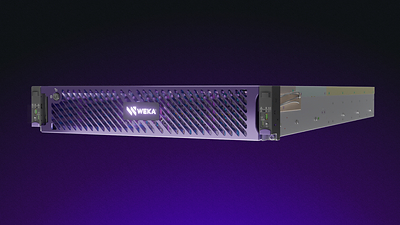
CAMPBELL, Calif., July 21, 2026 /PRNewswire/ — WEKA, the AI data and memory infrastructure company, today unveiled the third generation of its WEKApod Nitro, WEKApod Prime, and WEKApod Prime Max AI storage appliances, featuring custom-engineered chassis and patent-pending hardware innovations that deliver the highest performance and capacity density on the market today. Built to run seamlessly with WEKA’s new NeuralMesh 6 software, announced separately today, the systems deliver a unified AI inference infrastructure platform designed to help AI clouds, model builders, and enterprises scale production AI workloads while reducing infrastructure costs, footprint, power consumption, and operational complexity.
As organizations deploy long-context, agentic, and retrieval-driven AI workloads at massive scale, infrastructure architectures built for traditional enterprise data workloads and early machine learning-era training are struggling to deliver the GPU utilization, token throughput, operational scale, and infrastructure efficiency required for modern inference economics.
The new WEKApod systems were purpose-built by WEKA to address these challenges and are poised to shatter existing rack-level data storage benchmark records and redefine every dimension of AI economics, establishing a new scorecard for inference-era infrastructure. A single WEKApod system can deliver 1.1 exabytes of effective capacity in a single rack, with NeuralMesh data reduction running on a hardware foundation of 441.5 PB raw capacity, making it the first single-rack system to break the exabyte barrier. Throughput reaches 10.2 TB/s per rack. IOPS reach 210 million per rack.
To accomplish this, WEKA designed the system with a PCIe Gen 6 internal fabric, a cable-based, backplane-free drive interconnect, NVIDIA® ConnectX® SuperNIC™ networking enabling Spectrum-X Ethernet data plane connectivity, and a software-managed thermal architecture. The systems have multiple patents pending for their innovative chassis design, underlying drive-interconnect, thermal-management, and serviceability technologies.
“AI infrastructure built for traditional workloads cannot power the inference era. The constraints are different: rack space, energy, supply chain, and operational density now determine whether AI deployments produce margin or destroy it,” said Liran Zvibel, co-founder and CEO at WEKA. “We built WEKApod to operate inside those constraints rather than against them, on hardware WEKA designed and engineered specifically for inference-era computing, with a supply chain we control. It delivers upfront economics that compound with the best total cost of ownership across the full gamut of AI infrastructure requirements, establishing a new scorecard that we believe every customer running production AI at scale will soon evaluate their infrastructure decisions against.”
“As AI workloads scale and datacenter utilization continues to grow, modern systems need to deliver more performance, more capacity and more efficiency without demanding more floor space or power,” said Jason Hardy, VP of Storage Technology at NVIDIA. “NVIDIA Spectrum-X Ethernet networking gives WEKApod 3 the high-bandwidth, low-latency fabric needed to keep the storage-to-GPU data path clear at scale, helping customers get more out of every GPU they deploy.”
Why Agentic AI Requires a New Approach
The constraints driving AI infrastructure decisions today are both physical and procurement-related. US datacenter construction declined in 2025 for the first time since 2020. Grid connection queues in major markets stretch 4 to 7 years. Morgan Stanley projects a 49-gigawatt power shortfall in the US through 2028. At the same time, NAND markets remain constrained and OEM-channel lead times have stretched well beyond what infrastructure planning cycles can absorb. Storage that consumes rack space and power inefficiently is directly competing with GPUs for the same constrained physical resources. Storage built on hardware the vendor does not control inherits supply chain risk on top of that.
WEKApod is WEKA’s answer to those fundamental issues: a system built to reduce the datacenter footprint, reclaim critical rack space, and improve tokens per watt, without sacrificing token throughput or workload performance. Per rack unit, WEKApod leads every publicly available alternative in capacity and throughput density, by 267% in effective capacity and 114% in throughput, over the next-best system in each category. On the procurement side, WEKA controls component sourcing directly rather than inheriting OEM channel dependencies, giving AI cloud providers and enterprises the pricing stability and lead-time predictability that infrastructure planning at scale actually requires.
For sovereign AI cloud providers and hyperscalers, that means more GPUs and more tenants per rack. For AI builders and enterprise teams, it means more inference capacity within their existing datacenter footprint.
“Inference at production scale is a fundamentally different infrastructure problem than training. The metrics that matter most are tokens per rack, tokens per watt, cost per inference at sustained load. Most vendors in this category have optimized for legacy benchmarks while the workloads have moved on,” said Steve McDowell, Chief Analyst, NAND Research. “WEKApod is engineered to support the metrics that customers need most now, with a unified hardware and software approach that reflects that. Anyone planning to build out AI infrastructure in today’s constrained datacenter and memory market should be evaluating every vendor against this new scorecard, regardless of which vendor they ultimately choose.”
WEKApod Nitro: Maximum Performance. Optimized for Inference Workloads.
WEKApod Nitro was built and configured for the most performance-critical AI workloads, where storage bandwidth determines whether GPUs run at full saturation or stall waiting on data. A two-rack-unit, four-node chassis offers four fully independent failure domains and 56 TLC drives, paired with dual-port NVIDIA ConnectX networking, delivering 800 Gb/s throughput.
WEKApod Prime and WEKApod Prime Max: Massive Capacity. Minimal Footprint.
- WEKApod Prime delivers balanced capacity and performance from an AlloyFlash TLC and QLC mix in a four-node, two-rack-unit chassis with 56 total drives.
- WEKApod Prime Max was built and configured to deliver maximum capacity in the smallest possible footprint. A two-rack-unit, two-node chassis packs 70 NVMe drives. NeuralMesh’s high-performance object storage and always-on data reduction, combined with Micron’s 245.76 TB 6600 ION drives, enable WEKApod Prime Max to deliver 1.1 exabytes of effective capacity in a single 56U rack — density no competitor can match.
“Agentic AI and inference are raising the bar for data center efficiency, requiring density, power and performance to scale together,” said Jeremy Werner, senior vice president and general manager of Micron’s Core Data Center Business Unit. “With the new WEKApod architecture and Micron 245TB SSDs, customers can deliver 15.8 petabytes in a 2U footprint, maximizing storage capacity while preserving power and space for additional compute.”
Key WEKApod Features and Benefits
- Custom-Engineered 2U Chassis: Delivers the highest performance and capacity density available on the market today in the smallest possible footprint. The same enclosure supports both four-node and two-node configurations.
- Built on PCIe Gen 6 Internal Fabric: Delivers bandwidth headroom for every drive to run at full utilization simultaneously.
- Micro Failure-Domain Design for High-Density Drives: A backplane-free environment creates fully independent failure domains and contains incidents to a single drive, preventing the need for cluster-level interventions.
- Thermal Architecture Engineered for 35°C Ambient Operation: Software-managed NVMe power throttling under thermal stress means the system degrades gracefully rather than triggering shutdown. At production AI scale, this is the difference between a performance event and an SLA breach.
- Built-In Serviceability: Hot-pluggable boot drives delivered via a custom interposer with GUI-guided replacement. Mirrored NIC port layout keeps drive bays accessible during maintenance. A drive replacement is a 10-minute self-service operation, not a 2-hour maintenance window.
- Headless Deployment: Cloud-driven rack-scale installations via NeuralMesh Home.
- Configurable Appliances From Sub-1PB to 100PB and Beyond: The third-generation WEKApod Nitro, WEKApod Prime, and WEKApod Prime Max are the first WEKApod products sold as configurable SKUs. Chassis type, memory, drive capacity, and drive count are customer-selectable. Every configuration offers the same operational simplicity.
Availability
WEKApod Nitro, WEKApod Prime, and WEKApod Prime Max are available to order today through WEKA’s worldwide distributor and VAR network for delivery beginning in Fall 2026. NeuralMesh 6 will ship with the first systems.
For more information about the new WEKApod appliances, visit: https://www.weka.io/product/wekapod/.
WEKA NeuralMesh x WEKApod: Built to Run In Perfect Symmetry Together
WEKA also debuted the sixth generation of its flagship NeuralMesh software platform today, with new enterprise-grade features, including native multi-tenancy, a unified file-and-object protocol stack, intelligent metadata-first data resiliency, always-on data efficiency with contractual performance guarantees, Kubernetes-native operations, and unified observability. See today’s NeuralMesh 6 announcement to learn more: https://www.weka.io/news/neuralmesh-6-enterprise-agentic-ai.
About WEKA
WEKA is the AI data and memory infrastructure company transforming the economics of agentic AI. Its NeuralMesh™ platform unifies high-performance data storage with extended GPU memory, giving enterprises, AI cloud providers, and AI builders a single foundation for training, inference, and agentic workloads. With Augmented Memory Grid, NeuralMesh extends GPU memory capacity by 1000x, accelerates time to first token by up to 20x, and delivers 10x more concurrent users from the same GPU footprint, proven in production benchmarks. Trusted by 30% of the Fortune 50, WEKA enables organizations to scale AI faster, optimize GPU utilization, and reduce the cost of every token served. Learn more at www.weka.io or connect with us on LinkedIn and X.
 View original content to download multimedia:https://www.prnewswire.com/news-releases/weka-unveils-wekapod-3-the-worlds-densest-ai-storage-and-memory-system-for-agentic-workloads-302828344.html
SOURCE WEKA


