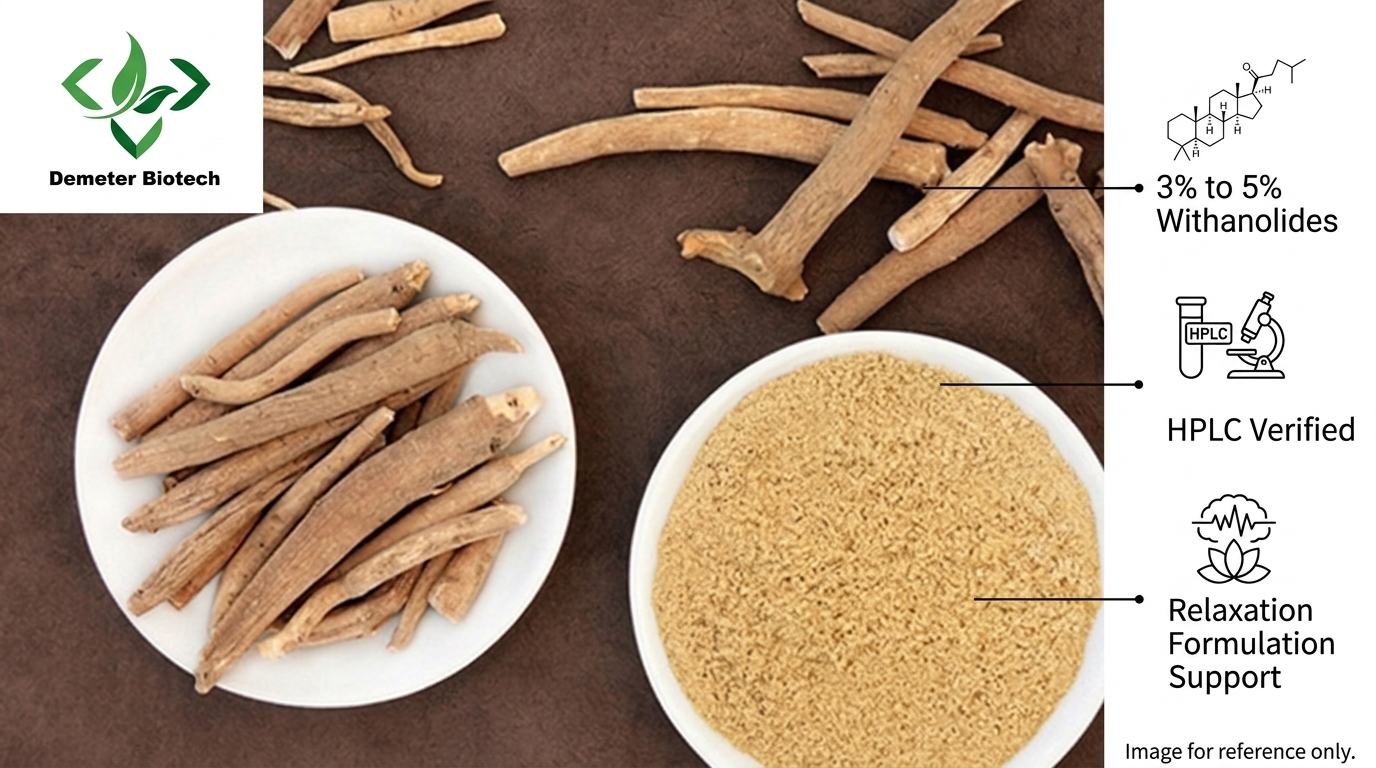
XI’AN, SHAANXI, CHINA, August 12, 2026 /EINPresswire.com/ — For brands developing stress-relief formulations, the choice of an ashwagandha ingredient rarely comes down to the plant name alone. What decides a shortlist is the availability of a definable active-compound specification, batch documentation, and a form that fits the intended dosage. A High Quality Ashwagandha Extract Factory earns its place by turning that requirement into a reviewable starting point rather than a marketing label. Ashwagandha extract, a plant extract drawn from the ashwagandha root, becomes useful to a formulator only when its standardized active content is stated clearly.
Xi’an Demeter Biotech Co., Ltd. supplies ashwagandha extract with withanolides from 1% to 10%, together with water-soluble decaffeination withanolide grades and KSM-66. This range gives supplement, functional-food, and beverage developers several defined starting points for ingredient screening. The company positions the material within its plant extract portfolio, where a stated specification, a defined test method, and batch records matter more than broad wellness language. The sections below trace how standardization, a documented factory quality system, and application fit connect for teams evaluating an ashwagandha supplier.
Standardized Withanolides Define the Starting Point for Stress-Relief Formulations
The quality baseline for ashwagandha extract is its active-compound specification, not an abstract botanical claim. Demeterherb‘s approved range covers withanolides from 1% to 10%, water-soluble decaffeination withanolide grades, and KSM-66. These options let a formulation team match the ingredient to its dosage form, label information, and batch-acceptance criteria. The selected grade should be named explicitly in the inquiry and confirmed against the COA. A defined range reduces the ambiguity that often stalls early sourcing conversations.
Standardization does more than produce a percentage on a spec sheet. For projects that need a stable ingredient profile, the defined withanolides range gives research, procurement, and quality teams a single baseline to work from, with per-batch verification still completed through the certificate of analysis and finished-product testing. The product record identifies HPLC as the test method and confirms that a COA is available for each batch, so the stated specification can be checked against incoming material rather than taken on trust.
Factory Quality Systems Turn a Product Claim into a Reviewable Supply Record
A high quality ashwagandha extract factory is judged less by how often the word factory appears in its copy and more by how specification, testing, and quality management combine into a traceable supply record. The company profile published by Demeterherb lists GMP production standards along with ISO22000, Halal, Kosher, EU Organic, USDA Organic, and FDA credentials at the company level. These are company qualifications and are not extended here into a product-level organic claim for the ashwagandha extract itself.
Xi’an Demeter Biotech Co., Ltd. treats its GMP production controls standard and ISO22000 food-safety management system as the framework behind its plant extract supply. Read alongside the product page details, which include the HPLC test method, COA availability, and a 24-month shelf life, this lets a formulation brand focus its supplier screening on specification consistency, document completeness, and storage requirements. The distinction between company-level certification and product-level specification remains clear so buyers know what each record covers.
Formulation Innovation Begins with Application Fit, Not Medical Overstatement
Innovation in stress-relief formulations is best understood as coordination among dosage form, blend logic, and ingredient documentation, rather than a promise that a single botanical extract can treat or diagnose anything. The 1%-10% withanolides range, water-soluble decaffeination withanolide grades, and KSM-66 give developers distinct starting points for supplement, functional-food, or beverage projects. Inclusion levels, stability, and label wording still depend on the target market’s regulations and on validation of the finished product.
Demeterherb groups its ashwagandha extract within its plant extract and relax and sleep product pathways, which shows the material can enter formulation discussions organized around relaxation and sleep occasions without overreaching on health outcomes. The workable part of formulation innovation is aligning the ingredient specification, the HPLC test basis, and the COA with the sensory, stability, and regulatory review that every finished product requires. Handled this way, the ingredient supports development work instead of carrying claims it cannot substantiate.
A Practical Sourcing Framework for Ashwagandha Extract Factory Evaluation
A procurement review of a high quality ashwagandha extract factory can begin with four items a buyer is able to check directly: the withanolides standardization range, the HPLC test basis, the per-batch COA, and the company quality-system documentation. This framework reduces the word high quality to a set of comparable ingredient and documentation conditions, so evidence replaces unverified rankings, therapeutic claims, or an organic label that the product does not carry.
The ashwagandha extract product information and the company quality records offer two layers of review. The first answers questions about ingredient specification and basic testing; the second addresses company-level GMP and ISO22000 management signals. Before placing an order, a buyer still needs to confirm the target specification, packaging, transport conditions, regulatory suitability, and batch documentation so the material matches the specific project. Kept in this order, the evaluation stays practical and keeps the two layers of evidence from being confused with one another.
By bringing its 1%-10% withanolides range, water-soluble decaffeination withanolide grades, KSM-66, HPLC test information, and COA records into ashwagandha supply discussions, Xi’an Demeter Biotech Co., Ltd. lets brands begin from defined specifications. That approach reflects the company philosophy of being customer-focused, employees-fundamental, and quality-oriented. It gives supplement, functional-food, and beverage teams a dependable place to start.
Formulators and procurement teams evaluating ashwagandha supply can visit www.demeterherb.com to contact Demeterherb and request product documentation, a COA, and supply information matched to their target specification. Product and category details are also available on the company’s relax and sleep and plant extract pages.
About Demeterherb
Xi’an Demeter Biotech Co., Ltd., known as Demeterherb, is a China-based supplier of plant extracts, fruit and vegetable powders, and related ingredients for the nutrition supplement, functional food, and beverage industries. The company operates under GMP production standards and holds ISO22000, Halal, Kosher, EU Organic, USDA Organic, and FDA credentials at the company level, and it serves customers in more than 50 countries and regions.
Xi’an Demeter Biotech Co., Ltd.
Demeterherb
email us here
Visit us on social media:
LinkedIn
Facebook
X
Legal Disclaimer:
EIN Presswire provides this news content “as is” without warranty of any kind. We do not accept any responsibility or liability
for the accuracy, content, images, videos, licenses, completeness, legality, or reliability of the information contained in this
article. If you have any complaints or copyright issues related to this article, kindly contact the author above.

Media gallery