Fibrotic Diseases Treatment Market to Surge from USD 27.4 Bn in 2025 to USD 58.1 Bn by 2035—By the Escalating Disease Burden, Pipeline Finally Reaching Readout
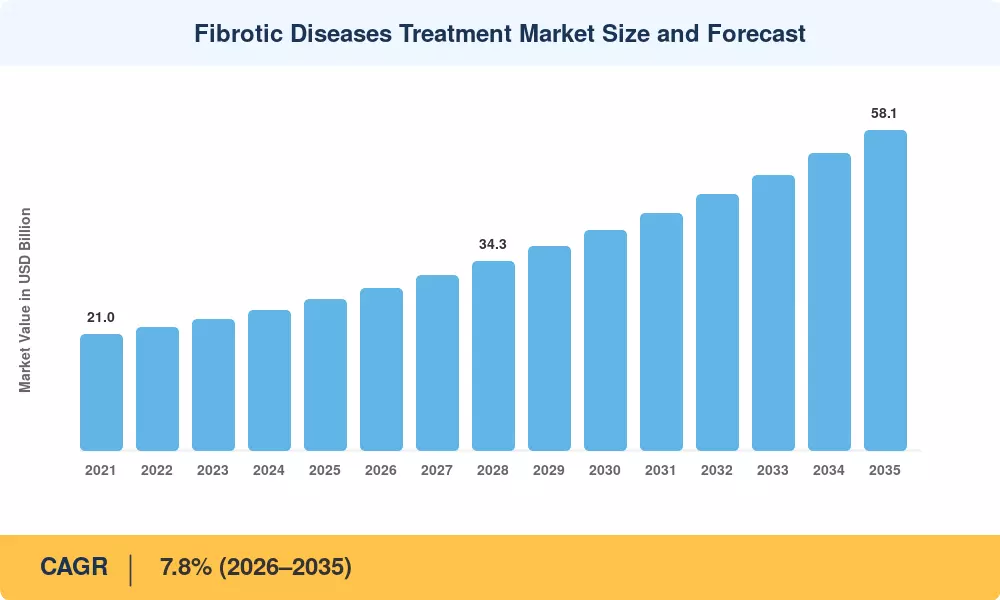
NY, CA, UNITED STATES, September 17, 2026 /EINPresswire.com/ — As per Market Research Future, the global Fibrotic Diseases Treatment Market size is projected to reach USD 58.1 Billion by 2035 from USD 27.4 Billion in 2025, at a CAGR of 7.8% during the forecast period 2026–2035. The market base was estimated at USD 27.4 Billion in 2025, with the first year of the forecast period (2026) valued at USD 29.5 Billion.
The 7.8% CAGR is propelled by three converging forces: the escalating disease burden, with around 50,000 new idiopathic pulmonary fibrosis diagnoses recorded annually in the United States and specialist-care prevalence in Europe measured at 36.0 per 100,000 population, plus the WHO attributing over 1.3 million annual deaths to cirrhosis; a pipeline finally reaching readout, with ClinicalTrials.gov listing 214 interventional fibrosis studies in active recruitment as of Q4 2025 against 118 five years earlier; and metabolic liver disease as a volume engine, with roughly 38% of adults in high-income economies now carrying steatotic liver disease and 5–7% of those progressing to significant fibrosis.
Global regulatory incentives and payer behaviour are amplifying this momentum. The U.S. FDA’s expanded orphan-drug incentive framework has kept idiopathic pulmonary fibrosis programs commercially viable despite trial attrition rates above 60%, while the European Commission’s Innovative Health Initiative committed EUR 2.4 billion across 2021–2027 to chronic organ-injury research. Global venture and corporate investment into fibrosis-focused biotechs exceeded USD 4.1 billion between 2023 and 2025, with roughly 38% of that capital directed at hepatic indications. Nintedanib and pirfenidone now sit on reimbursement formularies in 47 countries, converting a niche specialty category into a durable revenue base. North America holds 41.5% of 2025 revenue, supported by dense pulmonology referral networks and the highest per-patient reimbursement ceilings anywhere, while Asia-Pacific grows fastest at a 9.4% CAGR through 2035, propelled by China’s NRDL expansions and India’s biosimilar manufacturing base.
Request A Free Sample:
https://www.marketresearchfuture.com/sample_request/37026
Key Market Trends & Growth Drivers
Escalating Disease Burden
Prevalence data leaves little ambiguity. Around 50,000 new idiopathic pulmonary fibrosis diagnoses are recorded annually in the United States, and specialist-care prevalence in Europe was measured at 36.0 per 100,000 population. Chronic liver disease compounds the picture—the WHO attributes over 1.3 million annual deaths to cirrhosis, with roughly a quarter now traced to metabolic rather than viral aetiology. Each additional diagnosed patient converts into eight to fourteen years of treatment demand, which is why volume, not price, drives most of the growth modelled here.
A Pipeline Finally Reaching Readout
Clinical activity has thickened considerably. ClinicalTrials.gov listed 214 interventional fibrosis studies in active recruitment as of Q4 2025, against 118 five years earlier. Boehringer Ingelheim’s nerandomilast programme, Pliant Therapeutics’ integrin inhibitors, and multiple LPA1 antagonists have all cleared Phase II. Success rates remain punishing, but even a 20% approval yield across the current cohort would add three to four disease-modifying options by 2032—enough to fracture the current duopoly in pulmonary care.
Metabolic Liver Disease as a Volume Engine
Hepatic indications are reshaping the revenue mix. Roughly 38% of adults in high-income economies now carry steatotic liver disease, and 5–7% of those progress to significant fibrosis. The 2024 accelerated approval of resmetirom created the first commercially reimbursed pathway for F2–F3 patients, and payers in the US, Germany, and Japan have since funded screening cascades in diabetes clinics. That screening layer, more than the drug itself, is what expands the addressable base.
Diagnostics Pulling Demand Forward
Elastography and blood-based panels have cut the cost of staging fibrosis by an estimated 62% versus biopsy while removing procedural risk. NHS England’s community liver-health pathway screened over 400,000 at-risk adults between 2023 and 2025, identifying advanced fibrosis in approximately 4.8% of them. Earlier detection lengthens the treatment window per patient—a structural, compounding tailwind for the Fibrotic Diseases Treatment Market.
Ask for Customization:
https://www.marketresearchfuture.com/ask_for_customize/37026
Market Segment Insights
BY TREATMENT
Medication: Largest segment with 58.2% share in 2025 , reflecting the entrenchment of oral antifibrotics in first-line care. Two approved oral agents anchor pulmonary care globally, and the 2024 entry of a metabolic-liver agent opened a second commercial pillar.
Organ Transplantation: Significant segment at USD 5.9 Billion in 2025, driven by end-stage hepatic and pulmonary disease. Demand vastly exceeds supply, with roughly 2,700 lung transplants and 9,200 liver transplants performed annually in the United States and Europe combined against waiting lists several times longer.
Oxygen Therapy: Fastest-growing treatment line at 6.1% CAGR (2026–2035) , driven by supportive care in advanced IPF.
Others: Significant segment at USD 1.9 Billion in 2025, including pulmonary rehabilitation and palliative support.
BY APPLICATION
Idiopathic Pulmonary Fibrosis: Largest application with 38.4% share in 2025 , anchored by two approved global standards of care. Median survival without treatment sits near three years, which concentrates urgency and supports premium pricing.
Hepatic Cirrhosis: Significant segment at USD 7.6 Billion in 2025, driven by MASH progression and viral sequelae. Metabolic dysfunction-associated steatohepatitis has created a screening-driven patient funnel that did not exist five years ago.
Renal Fibrosis: Fastest-growing application at 9.1% CAGR (2026–2035) , driven by diabetic and hypertensive kidney disease. Grows fastest in percentage terms but from a base with almost no approved targeted therapy.
Cutaneous Fibrosis: Significant segment at USD 2.8 Billion in 2025, driven by systemic sclerosis and keloid management.
BY END USER
Hospitals: Largest segment with 62.5% share in 2025 , driven by specialist initiation, infusion and transplant capability. Staging, multidisciplinary review, and tolerability monitoring all require specialist infrastructure.
Academic and Research Institutes: Significant segment at USD 6.5 Billion in 2025, driven by trial participation and tertiary referral. Academic centres punch above their volume share, capturing complex cases and serving as trial sites.
Others: Fastest-growing end user at 7.4% CAGR (2026–2035) , including specialty clinics and home-based care. Community and home-based settings expand fastest as oral regimens mature and remote spirometry makes decentralized monitoring viable.
Read Detailed Insights:
https://www.marketresearchfuture.com/reports/fibrotic-diseases-treatment-market-37026
Regional Outlook
North America — Dominant Market (~41.5% Share, 2025)
United States: Generates approximately 86.4% of regional revenue , driven by the highest global reimbursement ceilings. Roughly 1,200 pulmonology and hepatology centres are capable of initiating antifibrotic therapy, plus a specialty pharmacy channel that manages titration and adherence.
Canada: Contributes USD 1.1 Billion, driven by provincial formulary harmonization. Canada moves more slowly through pCPA negotiation.
Mexico: Fastest-growing in the region at 8.9% CAGR (2026–2035) , driven by IMSS specialty coverage expansion. Growth reflects a low base rather than mature capacity.
Europe — Second Largest (USD 7.1 Billion, 2025)
Germany: Holds 23.8% of regional revenue , driven by dense ILD centre network and early access pathways. Germany’s system of accredited interstitial lung disease centres captures patients earlier than most peers.
United Kingdom: Contributes USD 1.2 Billion, driven by NICE-approved pathways and community liver screening. The community-based liver pathway now operates across 20 integrated care systems.
France: Holds 15.2% of regional revenue , driven by RIHN diagnostic funding.
Italy: Contributes USD 0.8 Billion, driven by AIFA innovative-medicines fund.
Spain: Holds 7.4% of regional revenue , driven by regional hepatology programmes.
Nordic Countries: Growing at 8.1% CAGR (2026–2035) , driven by registry-driven early diagnosis.
Russia: Contributes USD 0.4 Billion, driven by domestic generic substitution.
Rest of Europe: Holds 9.6% of regional revenue , driven by EU cross-border referral schemes.
Asia-Pacific — Fastest-Growing Region (9.4% CAGR, 2026–2035)
China: Holds 38.6% of regional revenue , driven by NRDL inclusion and hospital tender volumes. China alone diagnoses an estimated 130,000 new interstitial lung disease cases annually.
India: Fastest-growing in the region at 11.2% CAGR (2026–2035) , driven by low-cost generics and expanding pulmonology base. India exports generic antifibrotics to more than 60 markets.
Japan: Contributes USD 1.5 Billion, driven by universal coverage and aging population. High prices, universal coverage, and the world’s oldest population produce the region’s highest revenue per patient.
South Korea: Holds 8.4% of regional revenue , driven by HIRA reimbursement and transplant capacity.
ASEAN: Contributes USD 0.5 Billion, driven by JKN and comparable national schemes.
South America — Growing Presence (USD 1.5 Billion, 2025)
Brazil: Anchors the region with 58.3% of revenue , driven by SUS specialty procurement. Centralized SUS purchasing delivers volume at compressed margins.
Argentina: Contributes USD 0.3 Billion, driven by PAMI coverage for elderly patients.
Middle East & Africa — Emerging Opportunity (4.5% Share, 2025)
Saudi Arabia: Holds 31.5% of regional revenue , driven by Vision 2030 healthcare investment. The health-sector transformation programme has funded new tertiary transplant and pulmonology units in Riyadh and Jeddah.
UAE: Contributes USD 0.24 Billion, driven by mandatory insurance and medical tourism.
South Africa: Holds 16.8% of regional revenue , driven by private-sector pulmonology capacity.
Egypt: Fastest-growing in the region at 10.3% CAGR (2026–2035) , driven by post-HCV cirrhosis management programmes. Egypt’s mass hepatitis C elimination campaign cured millions but left a large cohort with established cirrhosis.
Rest of MEA: Contributes USD 0.31 Billion, driven by tertiary hospital construction.
Competitive Landscape and Recent Developments
Concentration is moderate and asymmetric, with the top five players holding approximately 47% of 2025 revenue—high enough that pricing discipline holds in pulmonary indications, low enough that hepatic and renal segments remain genuinely contestable.
KEY COMPANIES AND RECENT MILESTONES
Boehringer Ingelheim (September 2024): Reported positive Phase III results for nerandomilast in idiopathic pulmonary fibrosis, positioning the first genuinely new pulmonary mechanism in over a decade and reinforcing the company’s category leadership. Estimated ~14–17% revenue share.
Hoffmann-La Roche (Genentech):Broad respiratory and diagnostics integration with pirfenidone and autotaxin inhibitor programmes. Estimated ~11–14% revenue share.
Bristol Myers Squibb (June 2025): Advanced its LPA1 antagonist into pivotal pulmonary fibrosis trials following encouraging Phase II FVC data, signalling large-cap commitment to a mechanism previously dominated by smaller sponsors. Estimated ~6–9% revenue share.
Gilead Sciences (April 2025): Entered a licensing agreement with a clinical-stage biotech for hepatic antifibrotic assets, extending its liver franchise beyond antiviral therapy into fibrosis reversal. Estimated ~5–8% revenue share.
Madrigal Pharmaceuticals (March 2024): Secured accelerated FDA approval for resmetirom in MASH with moderate-to-advanced fibrosis, establishing the first reimbursed pharmacological pathway for hepatic fibrosis. Estimated ~3–5% revenue share.
FibroGen (November 2025): Restructured its pipeline around anti-CTGF programmes after strategic review, refocusing capital on fibrosis indications with the clearest regulatory precedent. Estimated ~2–4% revenue share.
Other Key Players: Novartis (~4–7%), Pfizer (~4–6%), Galapagos NV (~2–4%), Sanofi (~2–4%), Merck KGaA (~1–3%), United Therapeutics (~1–3%).
Recent Industry Developments:
European Commission (January 2024): Allocated an additional EUR 340 million under the Innovative Health Initiative toward chronic organ-injury and fibrosis consortia.
China NHSA (December 2023): Included additional interstitial lung disease therapies in the National Reimbursement Drug List, reducing patient out-of-pocket burden substantially.
NHS England (July 2024): Expanded community liver-health checks to 20 integrated care systems, screening high-risk adults with transient elastography.
Future Outlook: 2026–2035
The Fibrotic Diseases Treatment Market is projected to reach USD 58.1 Billion by 2035, growing at a CAGR of 7.8%, driven by escalating disease burden, pipeline maturation, and metabolic liver disease expansion.
New opportunities lie in:
Combination Regimens as the Next Standard of Care: Eight sponsors now have Phase II trials combining an established antifibrotic backbone with an integrin or autotaxin inhibitor, and successful readouts would roughly quadruple per-patient annual spend without enlarging the patient pool.
Asia-Pacific Access Expansion: China’s National Reimbursement Drug List added fibrosis-relevant agents in successive 2023 and 2024 negotiation rounds, cutting patient out-of-pocket cost by roughly 55% and multiplying prescription volumes.
Biomarker-Stratified Trial and Care Models: Enriching trials for likely responders can cut required sample sizes by 30–40%, with diagnostics vendors licensing validated stratification panels to pharma sponsors.
Real-World Data and Registry Monetization: The IPF-PRO and EU-IPFF registries now supply structured outcome data to sponsors for external control arms and post-marketing commitments.
Machine Learning in Fibrosis Staging: Regulatory clearances for quantitative interstitial lung disease scoring tools tripled between 2022 and 2025, with validation studies reporting agreement with expert radiologists in the 0.87–0.92 range.
Regenerative and Reversal Approaches: Cell-based approaches, senolytic agents, and matrix-remodelling enzymes have shown histological reversal in preclinical hepatic and renal models, with the first human proof-of-concept studies expected to read out before 2030.
By 2035, the Fibrotic Diseases Treatment Market is expected to achieve substantial growth, reflecting the transformation of fibrosis care from symptom control to disease modification and potential reversal.
More Related Research Insights:
https://www.marketresearchfuture.com/ja/reports/medical-nutrition-market-1330
https://www.marketresearchfuture.com/de/reports/medical-nutrition-market-1330
https://www.marketresearchfuture.com/es/reports/medical-nutrition-market-1330
https://www.marketresearchfuture.com/zh-cn/reports/medical-nutrition-market-1330
https://www.marketresearchfuture.com/ko/reports/medical-nutrition-market-1330
https://www.marketresearchfuture.com/fr/reports/nutrigenomics-market-4009
https://www.marketresearchfuture.com/ja/reports/nutrigenomics-market-4009
https://www.marketresearchfuture.com/de/reports/nutrigenomics-market-4009
https://www.marketresearchfuture.com/fr/reports/menstrual-cup-market-1407
https://www.marketresearchfuture.com/ja/reports/menstrual-cup-market-1407
https://www.marketresearchfuture.com/de/reports/menstrual-cup-market-1407
https://www.marketresearchfuture.com/fr/reports/light-therapy-market-8366
https://www.marketresearchfuture.com/ja/reports/light-therapy-market-8366
https://www.marketresearchfuture.com/de/reports/light-therapy-market-8366
https://www.marketresearchfuture.com/fr/reports/iv-hydration-therapy-market-32530
Market Research Future
Market Research Future
+1 855-661-4441
email us here
Legal Disclaimer:
EIN Presswire provides this news content “as is” without warranty of any kind. We do not accept any responsibility or liability
for the accuracy, content, images, videos, licenses, completeness, legality, or reliability of the information contained in this
article. If you have any complaints or copyright issues related to this article, kindly contact the author above.

Media gallery