How Modern Communication Keeps Distributed Employees Connected, Professional, and Productive
Newark, United States – March 23, 2026 / Phone.com /
Hybrid teams are only as strong as their phone systems.
-
Nearly 80% of employees with remote-capable jobs now work either hybrid or fully remote, making location-independent communication a business requirement.
-
Multi-line business phone systems allow simultaneous calls across team members, eliminating missed connections and busy signals that frustrate customers.
-
VoIP-powered solutions cost significantly less than traditional systems while providing mobile apps, call routing, and features that keep distributed teams unified.
If your team splits time between home and office, investing in the right multi-line system is the foundation of professional operations.
Hybrid work has become a permanent business strategy. With nearly a quarter of all job postings in late 2025 featuring hybrid arrangements and employees increasingly unwilling to sacrifice flexibility, businesses face a critical question: how do you maintain professional, reliable business phone communications when your team works from multiple locations?
The answer lies in multi-line business phone systems designed for distributed operations. These systems allow multiple team members to handle calls simultaneously, route inquiries to the right person regardless of their location, and present a unified professional image, whether someone answers from headquarters or their home office. For small businesses competing with larger organizations, getting this right means the difference between capturing opportunities and watching them slip to voicemail.
What Makes a Multi-Line Business Phone System Critical for Distributed Teams?
A multi-line business phone system enables your organization to manage multiple active calls at once across various users and devices. Unlike single-line setups that force callers to wait or leave messages, multi-line configurations ensure that when one team member is occupied, others can still answer incoming calls. This capability becomes exponentially more important when your team operates from different physical locations.
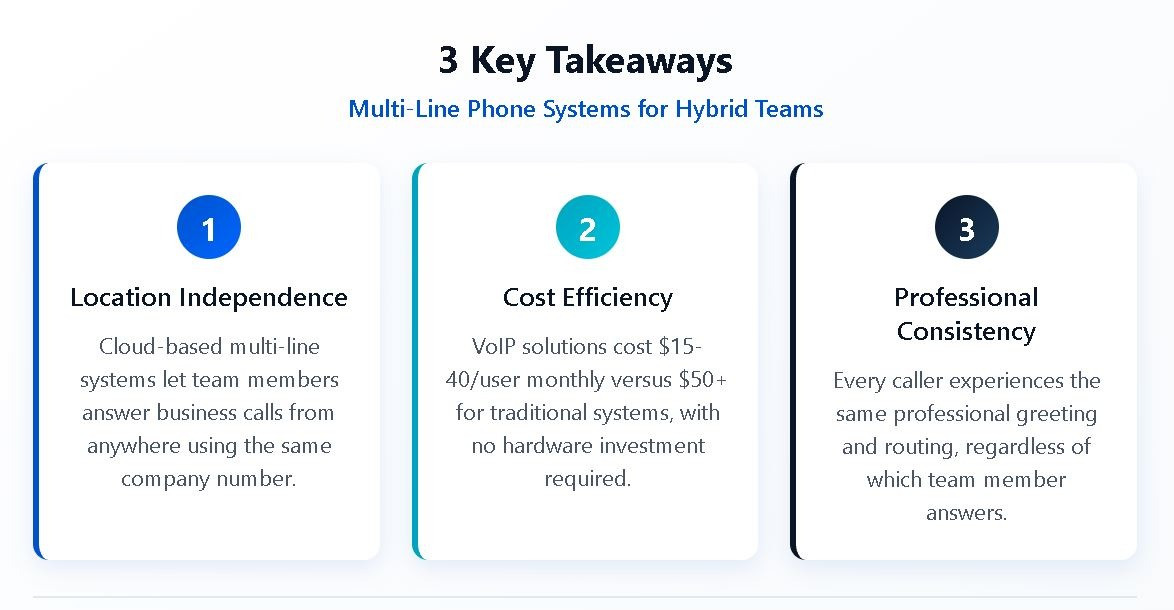
Traditional thinking assumed multi-line systems required expensive on-premise hardware tied to a single office. Modern VoIP technology has eliminated that constraint. Today’s cloud-based multi-line solutions route calls through the internet, meaning a team member in Chicago can share the same company number and call-handling capabilities as a colleague in Austin. The system doesn’t care where anyone sits; it only cares about connecting calls efficiently.
For hybrid teams specifically, this architecture solves the challenge of maintaining a consistent customer experience regardless of who answers and where they happen to be working that day. A client calling your main business number reaches the same professional greeting, the same menu options, and the same reliable routing whether your team is fully in-office, fully remote, or split across both arrangements.
What Communication Gaps Do Hybrid Teams Face Without Proper Phone Infrastructure?
When hybrid teams rely on personal cell phones or outdated single-line systems, communication breakdowns become inevitable. The most damaging consequence is inconsistency in how customers experience your business. A caller might reach someone’s professional voicemail one day and an informal personal greeting the next, creating confusion about whether they’ve contacted the right company.
Operational inefficiencies compound quickly. Team members miss important calls while handling other conversations. Customers encounter busy signals during peak hours. Employees struggle to transfer calls to colleagues working from different locations. Internal collaboration suffers because there’s no unified system for quick voice check-ins across the team.
Hybrid and remote employees report higher engagement than their fully on-site counterparts, but only when they have the tools to effectively stay connected. Without proper phone infrastructure, that engagement advantage disappears as frustration with communication barriers mounts. The technology supporting hybrid work must match the flexibility of the work arrangement itself.
The Hidden Costs of Fragmented Communication
Many small businesses underestimate what poor phone infrastructure actually costs them. Missed calls translate directly to missed revenue opportunities. A landscaping company that can’t answer inquiries while crews are in the field loses bids to competitors with more responsive systems. A consulting firm where partners juggle calls on personal devices projects an image that undermines their professional positioning.
There are also internal costs to consider. When team members lack efficient ways to reach each other by voice, they resort to lengthy email chains or scheduled video calls for conversations that could be resolved in a quick phone call. Productivity suffers when communication friction slows decision-making across locations.
5 Essential Features Your Multi-Line Business Phone Needs for Hybrid Success
Choosing the right business phone system requires understanding which features actually matter for distributed team operations.
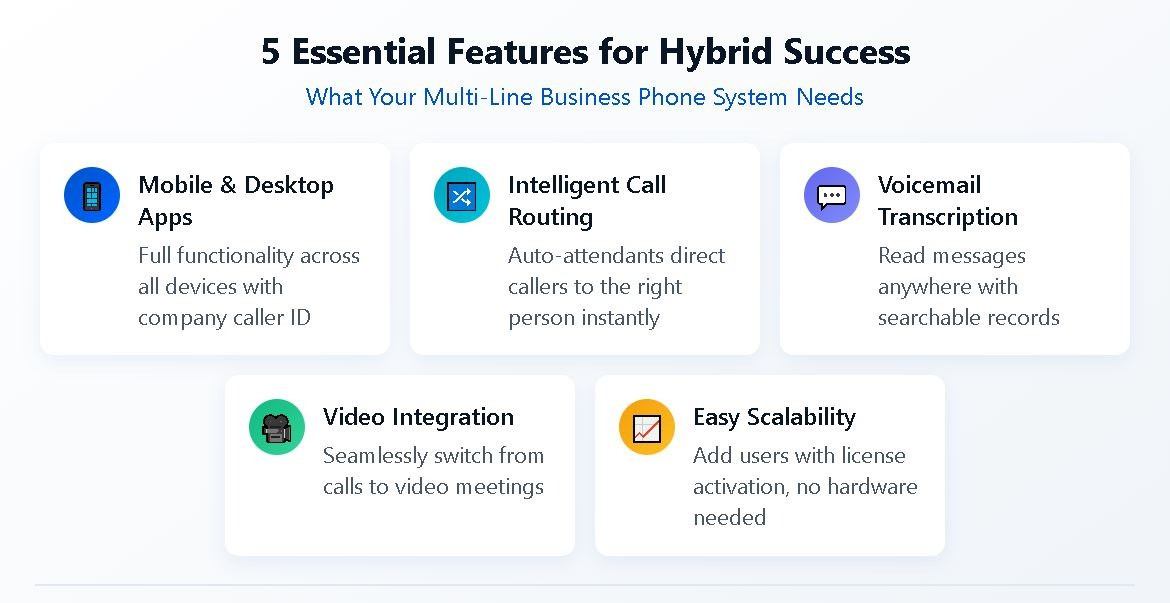
1. Mobile and Desktop Apps That Mirror Full Functionality. Your system should provide apps that let team members make and receive calls from smartphones, tablets, or computers using their business number. Calls placed from personal devices should display the company caller ID, and employees should access the same voicemail, call history, and contacts regardless of which device they use. This unified experience ensures professionalism while enabling true work-from-anywhere flexibility.
2. Intelligent Call Routing and Auto-Attendants. When callers reach your business, they should encounter professional greetings and menu options that direct them to the right person or department. For hybrid teams, routing rules should accommodate varying schedules, forwarding calls to mobile devices during certain hours and to other team members when someone is unavailable.
3. Voicemail Transcription and Unified Messaging. Reading voicemail transcriptions instead of listening to recordings saves time and allows team members to prioritize callbacks. Messages should appear in email or the phone app, creating a searchable record accessible from any location.
4. Video Conferencing Integration. A comprehensive VoIP phone system should include video meeting capabilities within the same platform. Hybrid teams benefit from seamlessly transitioning between voice calls and video conferences without switching between separate applications.
5. Scalability Without Hardware Investments. Adding new team members should require nothing more than activating additional user licenses. Cloud-based multi-line systems grow with your business, unlike traditional setups that demand expensive equipment installations for each expansion.
Why Do VoIP-Based Multi-Line Systems Outperform Traditional Options for Hybrid Teams?
The shift toward hybrid team VoIP solutions reflects practical advantages that legacy phone systems can’t match. Traditional multi-line setups require physical infrastructure, copper wiring, and PBX hardware installed at a specific location. When your team isn’t consistently in that location, the entire investment becomes a liability rather than an asset.
VoIP systems transmit calls over internet connections, removing location dependencies entirely. Your business number becomes portable, following team members wherever they work. This setup also enables cost structures that favor small businesses. Traditional systems often cost $50 or more per line monthly, plus substantial upfront hardware investments. VoIP services typically range from $15 to $40 per user monthly, with no hardware requirements for teams using smartphones and computers.
The Advantage of a Second Business Line for Personal Devices
Many hybrid employees prefer using a second business line on their personal smartphones rather than carrying separate devices. VoIP systems make this possible by providing app-based extensions that keep business and personal communications completely separated. Calls and texts to the business number appear in the business app, not mixed into personal messaging.
This arrangement benefits both employers and employees. Companies maintain control over business communications, call recordings, and professional standards. Employees preserve their personal phone numbers’ privacy while gaining the flexibility to handle business calls from familiar devices.
For small businesses, this approach eliminates the expense of providing company phones while ensuring that mobile apps deliver the full feature set team members need. A real estate agent can answer client calls professionally from open houses. A contractor can manage customer inquiries while on job sites. The business number stays consistent regardless of whose personal device happens to ring.
Frequently Asked Questions
How many phone lines does a small hybrid team typically need? Most small businesses start with four to eight lines, depending on team size and call volume. The advantage of VoIP-based systems is that adding lines requires no hardware changes, so you can start conservatively and scale up as needed.
Can team members share the same phone number for incoming calls? Yes. Modern multi-line systems support shared line appearance, allowing multiple users to answer calls from the same business number. Callers always reach someone available rather than hitting voicemail during business hours.
What happens if my internet connection goes down? Quality VoIP providers include failover features like automatic forwarding to mobile numbers or backup routing. Calls continue reaching your team even during internet outages at specific locations.
Keep Your Hybrid Team Connected With the Right Phone System
The communication demands of hybrid work require phone infrastructure built for flexibility, not legacy systems designed for everyone sitting in the same building. Multi-line business phone solutions powered by VoIP technology deliver the features distributed teams need without the complexity or cost of traditional alternatives.
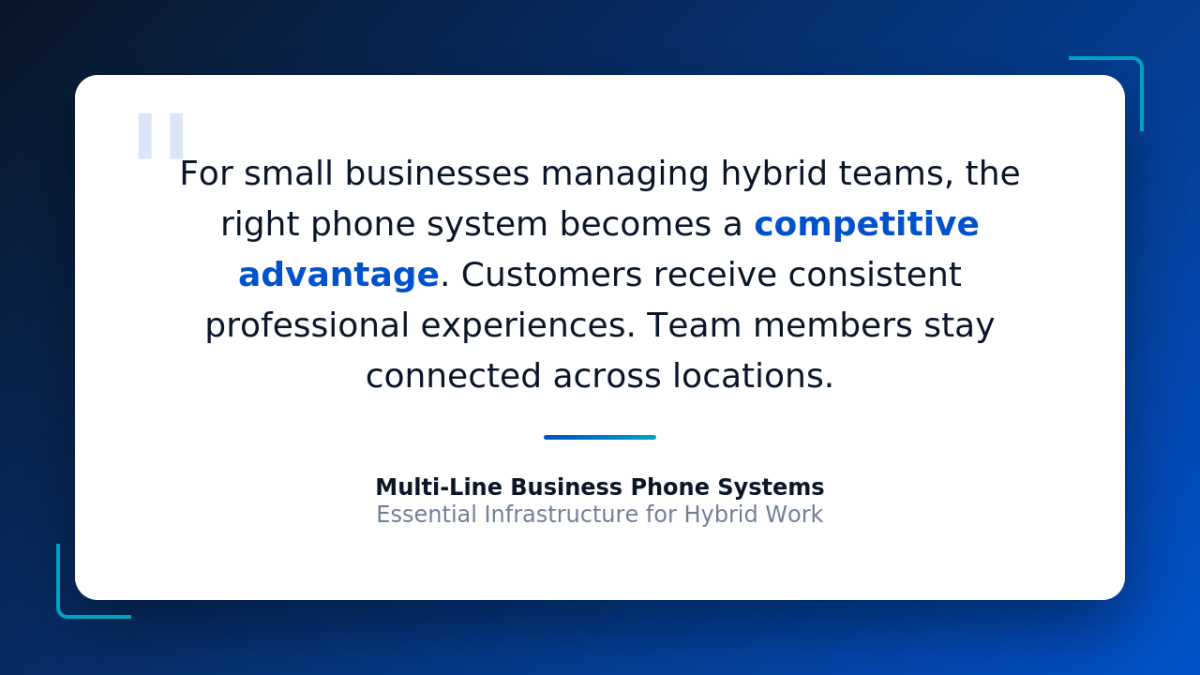
For small businesses managing hybrid teams, the right phone system becomes a competitive advantage. Customers receive consistent professional experiences. Team members stay connected across locations. The business projects an image that matches its ambitions rather than its physical footprint.
With 50+ features, mobile apps, and no long-term contracts, Phone.com provides the cloud-based communication tools small businesses need to operate professionally from anywhere.


Contact Information:
Phone.com
625 Broad Street
Newark, NJ 07102
United States
Amber Newman
https://www.phone.com/


