The Business Research Company’s Vacuum Cleaner Global Market Report 2026 – Market Size, Trends, And Forecast 2026-2035
LONDON, GREATER LONDON, UNITED KINGDOM, October 13, 2026 /EINPresswire.com/ — The vacuum cleaner market is set to experience significant growth over the coming years, driven by evolving consumer preferences and advancements in technology. As part of the broader Small Electrical Appliance sector, vacuum cleaners are carving out a notable share and demonstrating promising opportunities that reflect broader trends in home and commercial cleaning solutions.
Vacuum Cleaner Market Size and Its Role Within Small Electrical Appliances
Forecasts indicate that the vacuum cleaner market will surpass $16 billion by 2030. It forms an important segment of the Small Electrical Appliance market, which itself is expected to reach approximately $270 billion by the same year. More broadly, within the vast Electrical and Electronics industry projected at $5,579 billion in 2030, vacuum cleaners will constitute nearly 0.3% of the total market value, highlighting their steady but focused presence.
Request A Free Sample Of The Vacuum Cleaner Market Report
https://thebusinessresearchcompany.com/sample_request?id=21311867&type=smp&name=Vacuum%20Cleaner%20Market%20Report%202026&utm_source=EINPresswire&utm_medium=Paid&utm_campaign=Oct_PR
Steady Growth Anticipated in Vacuum Cleaner Market Through 2030
The vacuum cleaner sector is on course to achieve a compound annual growth rate (CAGR) of 8% up to 2030. This steady upward trajectory reflects growing consumer demand and ongoing innovation within the category, positioning it as a dynamic area of investment and development in the home appliance landscape.
Asia-Pacific to Lead Regional Vacuum Cleaner Market Expansion
By 2030, Asia-Pacific is expected to be the largest regional market for vacuum cleaners, valued at $8 billion, which is a rise from $5 billion in 2025. This growth rate of 8% CAGR is fueled by increasing household appliance penetration in developing countries, rising incomes supporting premium product purchases, urban housing trends favoring compact and efficient devices, and broader access to retail and online sale channels in the region.
Access The Detailed Vacuum Cleaner Market Report Here
https://thebusinessresearchcompany.com/report/vacuum-cleaner-global-market-report?utm_source=EINPresswire&utm_medium=Paid&utm_campaign=Oct_PR
China’s Role as the Dominant Country Market for Vacuum Cleaners
China is projected to hold the largest national market by 2030, with sales reaching $4 billion, up from $3 billion in 2025, growing at a 7% CAGR. The country’s strong performance is anchored by rising consumer spending on home improvement, a preference for energy-efficient appliances, competitive domestic manufacturing that helps maintain affordability, and innovations in smart cleaning technologies tailored to modern living spaces.
Leading Product Segment in the Vacuum Cleaner Market by 2030
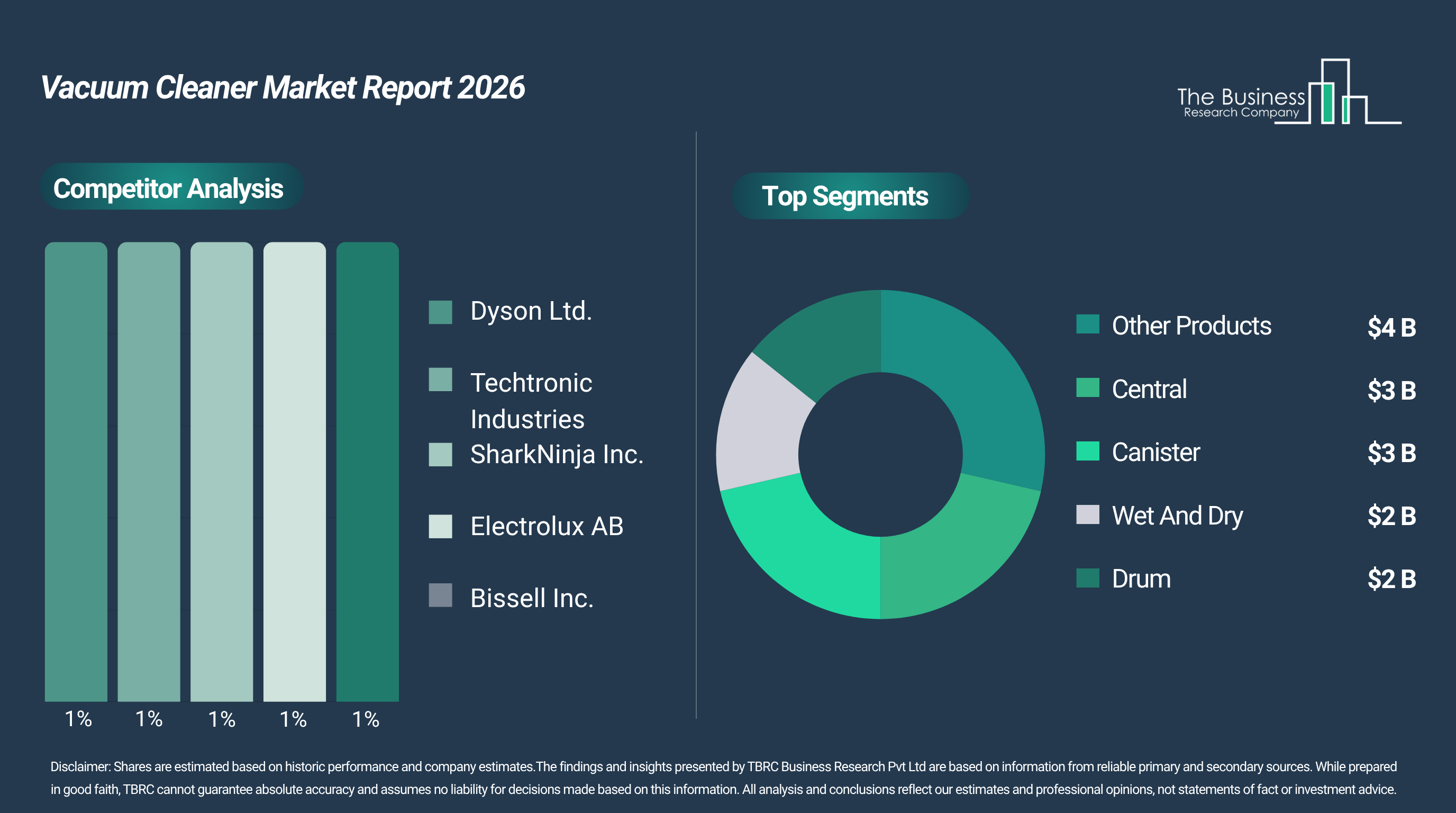
The market is divided into several product types including canister, central, drum, robotic, upright, wet and dry, along with other specialized products. Among these, the “other products” segment is expected to be the largest by 2030, representing 22% of the market or $4 billion. This segment’s strength lies in versatile and multifunctional cleaning equipment suited for niche residential and commercial applications, along with a consumer preference for appliances designed for specific tasks and ongoing diversification to meet evolving cleaning challenges.
Additional Segmentation by Application and Distribution Channels
Vacuum cleaners are also categorized by application into industrial, residential, and commercial sectors. Regarding sales channels, the market is split between online and offline distribution, reflecting the growing role of e-commerce alongside traditional retail outlets to meet consumer purchasing habits.
Factors Fueling Vacuum Cleaner Market Expansion
One of the primary engines driving market growth is the rapid adoption of smart and robotic vacuum cleaners. Consumers are attracted to these devices for their advanced features such as AI navigation, LiDAR mapping, obstacle detection, self-charging capabilities, and smartphone connectivity. Premium models with voice assistant integration, self-emptying dustbins, and adaptive cleaning routines appeal to buyers seeking convenience and efficiency. This trend is expected to contribute approximately 2.2% growth annually.
Heightened Attention to Hygiene and Indoor Air Quality Boosts Demand
A growing awareness of the importance of clean indoor environments, especially regarding allergens, dust, bacteria, and airborne particles, is prompting households and commercial users to invest in high-performance vacuum cleaners. Models equipped with HEPA filtration, sealed airflow systems, and multi-stage filters are particularly sought after for use in homes, healthcare facilities, hotels, schools, and offices. This factor is estimated to add about 2.0% to the market’s annual growth rate.
Urbanization, Increased Disposable Income, and Shifts in Lifestyle Patterns
The rise in urban populations, increased numbers of dual-income households, and changing consumer lifestyles are contributing to the demand for time-saving cleaning solutions. As consumers spend more on household appliances, the availability of cordless, multifunctional, and premium vacuum models is expanding, supported by the growth of both e-commerce and organized retail sectors. This driver is forecasted to account for roughly 1.7% annual market expansion.
Expanding Market Opportunities Across All Vacuum Cleaner Types
Each product category—including canister, central, drum, robotic, wet and dry, and upright vacuums—presents significant growth potential. Together, these segments are anticipated to add more than $6.4 billion to market value by 2030, with increments of about $1 billion each for most types except upright vacuums, which will grow by $0.4 billion from 2025 to 2030. Innovations like cordless batteries, AI-driven cleaning automation, energy-efficient and quieter motors, as well as smart home integration, will all drive this expansion.
Competitive Landscape of the Vacuum Cleaner Market
The global vacuum cleaner space is shaped by major home appliance manufacturers and specialized floor-care companies. These enterprises are investing heavily in improving suction power, cordless designs, intelligent navigation, filtration systems, and automation to meet evolving consumer demands. Competition centers on cleaning efficiency, ease of use, battery durability, dust capacity, and performance on various surfaces, offering insights for stakeholders seeking innovation, partnerships, and growth.
Top Market Leader in Vacuum Cleaner Sales by 2025
Dyson Ltd. stands as the leading vacuum cleaner brand globally in 2025, holding a 1% share of the market according to The Business Research Company. Dyson’s product range includes cordless stick vacuums, uprights, canister models, and robotic cleaners known for strong suction, advanced filtration, user-friendliness, and effective debris removal across both residential and commercial environments.
Market Fragmentation and Shares Among Leading Vacuum Cleaner Companies
The vacuum cleaner market is fairly fragmented, with the top 10 companies capturing only about 10% of total revenue in 2025. This indicates moderate barriers related to product innovation and distribution, alongside shifting consumer preferences and rapid technological advancements. Market leaders maintain their positions through diversified portfolios, brand recognition, extensive retail presence, and continuous innovation in cordless, robotic, filtration, and smart cleaning technologies. As consumer demand grows for convenient, automated, energy-efficient, and connected vacuum solutions, these companies are expected to strengthen their foothold through product differentiation and strategic partnerships.
Key Players Driving the Vacuum Cleaner Market Forward
Major companies active in this sector include Dyson Ltd., Techtronic Industries, SharkNinja Inc., Electrolux AB, Bissell Inc., LG Electronics Co. Ltd., Samsung Electronics Co. Ltd., Koninklijke Philips N.V., Miele & Cie. KG, and Nilfisk Group. Additional notable participants are Panasonic Holdings Corporation, SEB Group, Stanley Black & Decker Inc., Eureka Forbes, Haier Group Corp., Oreck Corporation, Numatic International, Goodway Technologies, CS Unitec Inc., Ghibli & Wirbel SpA, Quirepace Limited, Polivac International Pty. Ltd., Pullman-Ermator, American Vacuum Company, and Debus GmbH.
Multifunctional Vacuum Cleaner Technologies Reshaping Market Dynamics
The emergence of multifunctional vacuum models is transforming the market by offering enhanced versatility and convenience, enabling one device to handle multiple cleaning tasks across floor types and spaces. For example, in June 2026, SharkNinja introduced the Shark PowerDetect Transformer, a three-in-one vacuum that switches between a full-size upright, a lightweight stick, and a handheld unit. Features like PowerDetect and Reveal Technologies, Auto-Empty Systems, HEPA filtration, No Hair Wrap Technology, and DuoClean Detect brushrolls enhance cleaning efficiency and ease of maintenance for diverse environments including carpets, hard floors, stairs, upholstery, ceilings, and vehicles.
How Industry Leaders Are Innovating to Stay Competitive
Companies are leveraging AI-powered navigation for more precise autonomous cleaning, equipping vacuums with high-efficiency motors to boost suction and energy savings, and integrating self-cleaning systems to reduce maintenance efforts. Advances in filtration technology improve indoor air quality, while connected vacuum platforms allow for remote monitoring and integration with smart home ecosystems, all contributing to enhanced user experience and product performance.
Overview of the Vacuum Cleaner Market Value Chain
The supply chain involves raw material providers such as BASF SE, Covestro AG, SABIC, LyondellBasell Industries N.V., LG Chem Ltd., DuPont de Nemours Inc., Celanese Corporation, Evonik Industries AG, Toray Industries Inc., Asahi Kasei Corporation, Nidec Corporation, Domel d.o.o., Johnson Electric Holdings Limited, EDS International Inc., and Inno-Comp Kft.
Wholesalers and distributors include major players like Amazon.com Inc., Walmart Inc., Best Buy Co. Inc., The Home Depot Inc., Lowe’s Companies Inc., Target Corporation, Costco Wholesale Corporation, Wayfair Inc., Ferguson Enterprises LLC, W.W. Grainger Inc., MSC Industrial Direct Co. Inc., Fastenal Company, Bunzl plc, HD Supply Holdings Inc., and Sysco Corporation.
End users span hospitality giants such as Marriott International Inc., Hilton Worldwide Holdings Inc., Hyatt Hotels Corporation, InterContinental Hotels Group PLC, Accor SA, food service companies like Compass Group PLC, Aramark, Sodexo S.A., facility service providers including ISS A/S, and property management firms CBRE Group Inc., Jones Lang LaSalle Incorporated. Healthcare organizations such as HCA Healthcare Inc., Cleveland Clinic, and Mayo Clinic, as well as automotive companies like Toyota Motor Corporation, form a broad customer base.
Our latest 2026 market reports provide expanded strategic and visual intelligence with market attractiveness scoring and analysis, total addressable market (TAM) analysis, company scoring matrix graphics and tables, Excel-based forecasting dashboards, market hotspots infographics, key technologies and future trend analysis, together with updated graphics and tables.
Learn More About The Business Research Company
The Business Research Company (www.thebusinessresearchcompany.com) is a leading market intelligence firm renowned for its expertise in company, market, and consumer research. We have published over 30,000+ reports across 27 industries and 60+ geographies. Our research is powered by 1,500,000 datasets, extensive secondary research, and exclusive insights from interviews with industry leaders.
We provide continuous and custom research services, offering a range of specialized packages tailored to your needs, including Market Entry Research Package, Competitor Tracking Package, Supplier & Distributor Package and much more.
Disclaimer: Please note that the findings, conclusions and recommendations that TBRC Business Research Pvt Ltd delivers are based on information gathered in good faith from both primary and secondary sources, whose accuracy we are not always in a position to guarantee. As such TBRC Business Research Pvt Ltd can accept no liability whatever for actions taken based on any information that may subsequently prove to be incorrect. Analysis and findings included in TBRC reports and presentations are our estimates, opinions and are not intended as statements of fact or investment guidance.
Contact Us:
The Business Research Company
Americas +1 310-496-7795
Europe +44 7882 955267
Asia & Others +44 7882 955267 & +91 8897263534
Email: marketing@tbrc.info
Follow Us On:
LinkedIn: https://in.linkedin.com/company/the-business-research-company
Oliver Guirdham
The Business Research Company
+44 7882 955267
info@tbrc.info
Visit us on social media:
LinkedIn
Facebook
X
Legal Disclaimer:
EIN Presswire provides this news content “as is” without warranty of any kind. We do not accept any responsibility or liability
for the accuracy, content, images, videos, licenses, completeness, legality, or reliability of the information contained in this
article. If you have any complaints or copyright issues related to this article, kindly contact the author above.

Media gallery