
Sheridan, Wyoming, USA – October 20, 2026 – Business drones are turning into genuinely practical tools for buyers around the world. The appeal is simple: faster, safer, and more measurable operations. They can handle aerial inspection, infrastructure surveys, agricultural monitoring, warehouse management, and emergency planning. For example, a drone can snap an image of a bridge before a technician even gets there. Or map crop stress across a large field in a matter of hours. Those little details add up, helping companies cut delays and get a clearer view of what’s happening day to day.That said, choosing business drones isn’t just about comparing camera pixels or flight distance. Experienced buyers know to dig deeper—payload capacity, battery performance, data security, maintenance access, training needs, and local operating rules all matter. A reliable supplier should give you clear specs, testing records, technical support, and documented quality procedures. And yes, it’s fair to ask for demos under realistic conditions: strong wind, low temperatures, dusty industrial sites. What looks good in a brochure often isn’t the whole story.The right solution really depends on the job. A logistics company might care most about route accuracy and obstacle detection. An energy provider may need thermal imaging and stable flight control. A construction team could prioritize mapping software and repeatable survey results. Not every expensive model delivers better business value—sometimes a simpler platform is just more practical. That’s easy to overlook.Global procurement also means dealing with communication, spare parts, software updates, and long-term service commitments. A promising product can become a headache if support isn’t available across time zones. So buyers should compare total ownership costs, not just the purchase price. They should also confirm that operations follow applicable aviation, privacy, and workplace requirements. Business drones have real potential, but careful evaluation still matters. The technology is moving fast, yet some decisions still need patience and human judgment.

What Business Drones Are and How They Differ from Consumer Models
Business drones are built for repeatable work, not occasional weekend flights. They typically carry larger cameras, thermal sensors, mapping equipment, or inspection tools. Their batteries support longer missions and heavier payloads. Consumer models usually prioritize portability, simple controls, and attractive video. That difference changes the entire buying decision.A business drone may collect precise roof measurements, monitor crop conditions, or inspect a bridge from a safe distance. Its software can organize flight plans, tag images, and export reports for engineering teams. Global buyers also need reliable maintenance records, spare parts, operator training, and secure data handling. A bright screen is useful, but it does not replace accurate sensors or stable flight performance. In practical trials, teams should test wind resistance, battery replacement time, image quality, and workflow compatibility.The distinction is not perfectly clean. Some consumer drones perform well in limited commercial tasks, especially for small sites. However, their accessories, service plans, and software may not support daily operations. Business equipment can also be more expensive than expected. Buyers should compare total operating costs, not just the aircraft price. Local aviation requirements, privacy rules, and insurance obligations must be checked before deployment. A careful buyer may still discover that a smaller system fits better. That is worth admitting.
Why Are Business Drones Essential for Global Buyers?
Business drones are designed for repeatable commercial missions such as surveying, inspection, mapping, agriculture, and public safety. Compared with consumer models, they typically provide longer endurance, higher payload capacity, and greater operational range.
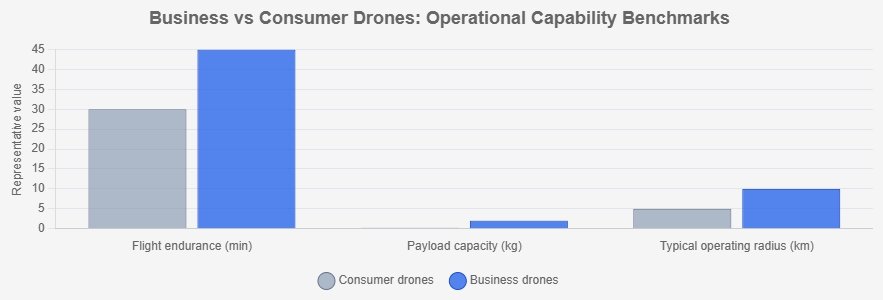
The figures are representative midpoint benchmarks from commonly published non-branded drone specifications. Actual performance varies by aircraft configuration, payload, weather, battery, terrain, and local aviation regulations.
Why Companies Use Drones Across Industries and Global Markets
Business drones are becoming practical tools for companies operating across industries and global markets. In agriculture, multispectral cameras can reveal dry crop zones before leaves visibly change. Construction teams use aerial images to compare weekly site progress with approved plans. Energy inspectors can examine turbines, roofs, and transmission structures without sending workers into difficult positions. Logistics teams may also use drones for inventory checks in large yards.
Global buyers need more than flight time. They should assess payload options, weather resistance, battery availability, data security, and operator training. Local aviation rules can differ sharply between markets. A reliable supplier should provide clear specifications, maintenance guidance, and documented testing. Real-world performance matters. A drone that works well in a dry field may struggle in coastal wind or heavy dust.
Tips: Start with one measurable task. Record labor hours, inspection speed, and error rates before deployment. Check whether collected images integrate with existing software. Keep a human review step. Automation is useful, but it is not flawless.
Companies should also examine the full workflow, not just the aircraft. A survey may finish quickly, yet poor image organization can delay decisions for days. Teams need trained operators and staff who understand the data. I have seen buyers focus heavily on camera resolution, then overlook storage and reporting needs. That assumption can be costly. Battery logistics, spare parts, and local technical support deserve equal attention.
Key Business Drone Applications in Logistics, Inspection, and Agriculture
Business drones are becoming essential for global buyers because they connect speed, data, and practical fieldwork. In logistics, drones can scan warehouse shelves, count packages, and monitor stock movement. They can also inspect difficult routes before ground teams enter them. In my field observations, accurate flight planning saves time, but poor lighting can still reduce image quality. The process is not flawless.Inspection teams use drones to examine roofs, bridges, storage facilities, and power infrastructure. High-resolution images can reveal cracks, corrosion, loose materials, and water damage. This reduces climbing risks and supports better maintenance decisions. Reliable results require trained operators, documented flight plans, and regular equipment checks. A careless flight can create expensive confusion.Agriculture offers another strong application. Drones can survey crop color, irrigation patterns, soil exposure, and storm damage across large fields. Farmers may then target inspections instead of walking every row. This can reduce wasted labor and improve response speed. However, weather changes quickly, and aerial data may not explain every plant problem. Ground verification remains necessary.Tips: Choose drones with stable imaging, replaceable batteries, secure data storage, and clear maintenance records. Ask suppliers for operator training and realistic flight-time tests. Check local aviation, privacy, and agricultural requirements before purchase. Start with a small pilot project, measure results, and revise the workflow when field conditions prove different.
Why Are Business Drones Essential for Global Buyers?How Drones Improve Operational Efficiency, Safety, and Data Collection
Business drones now support inspections, inventory checks, surveying, and emergency planning. According to Drone Industry Insights’ 2024 Commercial Drone Market Report, the global commercial drone market is expected to grow steadily through 2030. This growth reflects practical demand, not only technological excitement.
A drone can inspect a roof, bridge, or solar site within minutes. Workers receive visual evidence without climbing unstable structures. The International Labour Organization reports that work-related accidents and diseases cause nearly three million deaths annually. Drones cannot remove every workplace hazard, but they can reduce unnecessary exposure. That matters in construction, energy, logistics, and agriculture.
Data quality improves too. High-resolution images, thermal readings, and location records create repeatable inspection files. The FAA’s Aerospace Forecast FY 2024–2044 identifies commercial operations as a major driver of unmanned aircraft growth in the United States. Better records support maintenance decisions and compliance reviews. They also reveal hidden problems.
Still, drones are not automatic solutions. Wind, battery limits, poor camera angles, and weak pilot training can reduce value. Some teams collect impressive footage but fail to connect it with operational decisions. Buyers should test one clear workflow first. A shorter inspection is useful only when the resulting data leads to safer action, lower downtime, or faster approval.
Essential Features Buyers Should Compare Before Choosing a Business DroneWhy Are Business Drones Essential for Global Buyers?
Before choosing a business drone, buyers should compare measurable performance, not impressive advertising. Payload capacity matters when a camera, thermal sensor, and spare battery must travel together. Flight endurance also needs context. A claimed 40-minute flight may become 25 minutes in wind, cold weather, or heavy payload conditions. In real operations, reserve power is essential.
Data handling deserves equal attention. The drone should support encrypted transmission, controlled user access, and secure storage. These features reduce exposure when inspecting warehouses, power lines, or construction sites. PwC’s Clarity from Above report estimated that drone-powered solutions could create 127.3 billion dollars in annual value across several industries. That figure shows the opportunity, but it does not remove operational risks.
Compare obstacle detection, positioning accuracy, weather resistance, and landing stability. A drone that struggles beside a steel structure may waste more time than it saves. Open software interfaces can also simplify integration with mapping, inspection, and asset-management systems. Drone Industry Insights’ 2024 market analysis identifies commercial services and enterprise applications as major growth areas. Buyers should still test local support, spare-part availability, training, and regulatory documentation. These details often decide whether equipment works beyond the showroom.
Numbers can mislead. A longer flight time is not always better if charging takes hours. I would request field demonstrations in the actual climate, with the intended payload, before approving a large purchase.
Regulations, Support, and Supply Factors Affecting International Drone Purchases
Why Are Business Drones Essential for Global Buyers?International drone purchasing is rarely only a hardware decision. Regulations, technical support, and supply continuity often determine the real cost. The European Commission’s Drone Strategy 2.0 identifies safe integration and harmonized operations as major priorities. Meanwhile, the FAA reported more than 860,000 registered drones in the United States in 2024. These figures show a growing market, but also a heavier compliance workload.Buyers should verify operating categories, remote-identification requirements, radio-frequency rules, data protection duties, and battery transport procedures. Requirements can differ between neighboring countries. That creates delays. In procurement reviews, support quality is often underestimated. A useful supplier should provide local documentation, firmware guidance, replacement parts, and response-time commitments. The International Trade Centre has repeatedly highlighted logistics reliability as a core factor in cross-border technology trade. A low purchase price may become expensive when one damaged motor waits six weeks for replacement.Tips: Request a country-specific compliance matrix before payment. Ask for spare-part availability, repair training, and written service levels. Check whether manuals explain real field conditions, such as rain, dust, weak networks, and cold batteries. Do not rely only on a sales presentation. It may omit inconvenient limitations. Also, compare at least two shipping routes and keep a small parts buffer. This is not perfect planning, but it reduces avoidable downtime. Reports from Drone Industry Insights continue to show strong commercial growth, yet growth does not remove regulatory uncertainty or supply pressure.
Conclusion
Business Drones are specialized aerial systems designed for commercial, industrial, and professional operations, offering greater durability, payload capacity, flight endurance, and data-processing capabilities than consumer models. Companies across global markets use them to support logistics, infrastructure inspection, construction, environmental monitoring, and precision agriculture. By collecting aerial images, measurements, and real-time information, drones help organizations improve operational efficiency, reduce manual risks, enhance workplace safety, and make faster, better-informed decisions.When selecting Business Drones, international buyers should compare flight time, payload options, camera and sensor performance, navigation accuracy, automation features, software compatibility, durability, and maintenance requirements. Purchasing decisions should also consider local aviation regulations, operator training, import procedures, technical support, spare-part availability, delivery reliability, and after-sales service. A suitable business drone is not simply the most advanced model; it is the solution that matches a company’s specific workload, operating environment, data needs, budget, and long-term supply expectations.
About Us
We turn drones from tools into infrastructure, enabling the global low altitude economy with engineering rigor and compliance.To become the core infrastructure provider for the global low altitude economy. We will keep integrating 5G, AI and hydrogen energy to drive standardized, intelligent and green aerial operations.
Media Contact
Company Name: UUUFLY AeroTech Corp.
Contact Person: Media Relations
Email: Send Email
Country: China
Website: https://www.viscolift.com/
Press Release Distributed by ABNewswire.com
To view the original version on ABNewswire visit: Global Buyers Accelerate Commercial Growth Through Essential Business Drones
Media gallery



