The Business Research Company’s Fiber-To-The-Room (FTTR) Global Market Report 2026 – Market Size, Trends, And Forecast 2026-2035
LONDON, GREATER LONDON, UNITED KINGDOM, October 26, 2026 /EINPresswire.com/ — The Fiber-To-The-Room (FTTR) market is rapidly emerging as a key segment within the broader fiber optics and information technology sectors. With growing demand for enhanced in-building connectivity and ultra-fast broadband, FTTR is set to become a fundamental technology for residential, commercial, and enterprise applications. Here’s an in-depth look at the market’s size, regional leadership, key drivers, segments, major players, and competitive landscape shaping its future.
Fiber-To-The-Room Market Size and Its Parent Market Position
The FTTR market is projected to exceed $6 billion by 2030. When compared to its parent fiber optics market, which is expected to reach approximately $13 billion by the same year, FTTR will account for nearly 45% of this larger sector. Within the vast Information Technology industry, forecasted to hit $13,788 billion by 2030, FTTR will represent roughly 0.04% of the total market value, marking it as a niche but significant growth area.
Request A Free Sample Of The Fiber-To-The-Room (FTTR) Market Report
https://thebusinessresearchcompany.com/sample_request?id=72802342&type=smp&name=Fiber-To-The-Room%20%28FTTR%29%20Market%20Report%202026&utm_source=EINPresswire&utm_medium=Paid&utm_campaign=Oct_PR
Dominance of Asia-Pacific in the Fiber-To-The-Room Market by 2030
Asia-Pacific is set to lead the FTTR market geographically, with a valuation anticipated at $3.0 billion in 2030. Starting from $1.6 billion in 2025, the region is expected to grow at a compound annual growth rate (CAGR) of 13%. This rapid expansion is driven by surging demand for high-speed in-building connectivity, widespread adoption of smart homes and connected devices, growing next-generation broadband networks, substantial digital infrastructure investments, and strong government backing in countries such as China, Japan, South Korea, and India.
United States Expected to Be the Largest Single Country Market by 2030
The United States will emerge as the largest national market for FTTR, valued at $1.4 billion by 2030. This is a significant increase from $0.5 billion in 2025, reflecting a CAGR of 22%. The country’s market growth is fueled by extensive deployment of gigabit broadband networks, rising residential and enterprise demand for ultra-high-speed internet, adoption of smart home technologies, ongoing investments in fiber network upgrades, and government initiatives to expand broadband infrastructure nationwide. The increasing popularity of applications requiring low latency, such as cloud gaming and 8K streaming, further propels this growth.
Access The Detailed Fiber-To-The-Room (FTTR) Market Report Here
https://thebusinessresearchcompany.com/report/fiber-to-the-room-fttr-global-market-report?utm_source=EINPresswire&utm_medium=Paid&utm_campaign=Oct_PR
Largest Component Segment Within the Fiber-To-The-Room Market in 2030
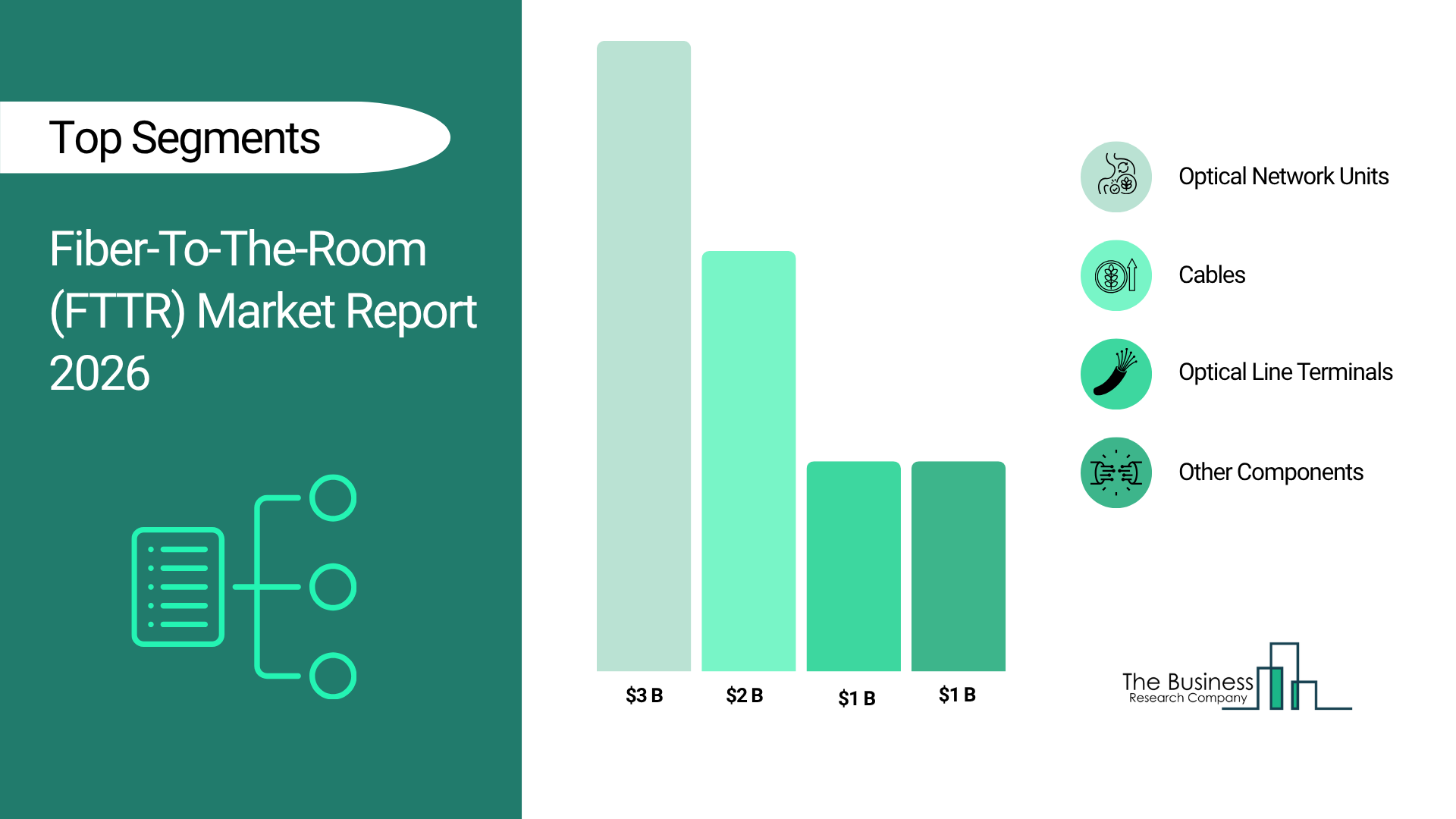
By component, the optical network units segment will be the largest in the FTTR market, accounting for 45%, or $3 billion, of the total market in 2030. This segment’s growth is supported by the rising need for high-capacity indoor optical distribution systems, deployment of multi-gigabit broadband connections, enhanced network management features, and improvements in compact, energy-efficient optical devices. Additionally, the demand for uninterrupted connectivity across multiple rooms and devices is driving innovation and adoption of advanced fiber-based customer premises equipment.
Overview of Fiber-To-The-Room Market Segmentation
The FTTR market is categorized by several dimensions. Components include optical network units, optical line terminals, cables, and other relevant parts. Service types cover installation and maintenance, consulting, and additional services. Deployment modes are divided into new installations and upgrades or retrofits. Applications span residential, commercial, hospitality, education, healthcare, and other sectors. End users comprise individual consumers, enterprises, and service providers, highlighting the broad reach of FTTR technology across various markets.
Anticipated Growth Rate of the Fiber-To-The-Room Market Through 2030
The FTTR market is forecasted to grow at a compound annual growth rate (CAGR) of 17% leading up to 2030. This robust pace reflects the accelerating demand for reliable, high-speed fiber connectivity solutions suitable for evolving digital environments.
Primary Growth Drivers Boosting the Fiber-To-The-Room Market
Increasing demand for ultra-fast, low-latency connectivity is a crucial factor propelling FTTR market expansion. Consumers and businesses alike are seeking seamless, high-bandwidth internet to support applications like 8K video streaming, cloud gaming, virtual reality, video conferencing, and smart home automation. FTTR technology delivers direct fiber-optic connections to individual rooms, offering stable gigabit speeds, minimal signal loss, and low latency compared to conventional Wi-Fi or copper-based networks. This performance ensures a smooth digital experience and supports future-ready connected environments.
The expanding adoption of smart homes and smart buildings is another important driver. The widespread integration of connected devices, IoT platforms, intelligent lighting, security systems, and building automation requires a highly reliable and high-speed network infrastructure. FTTR’s fiber-based connectivity across multiple rooms enhances network stability and bandwidth, making it an ideal solution for modern residential complexes, office buildings, hospitality venues, and more. This trend is expected to contribute significantly to ongoing market growth.
Contribution of Fiber Broadband Expansion and Next-Generation Network Infrastructure
Continued investments in fiber broadband and next-generation network infrastructure serve as a vital growth catalyst for the FTTR market. Telecom operators and governments are increasingly deploying gigabit fiber networks and advanced digital communication systems such as F5G architecture. FTTR extends fiber connectivity directly into individual rooms, enabling faster data speeds, improved network reliability, and comprehensive coverage to meet the demands of bandwidth-intensive applications. This infrastructure expansion supports the development of smart homes, digital enterprises, and future-ready networks, further fueling market momentum.
Key Growth Opportunities Across Fiber-To-The-Room Market Segments in 2030
Significant market opportunities exist within the optical network units, optical line terminals, cables, and other components segments. Combined, these areas are expected to generate over $4.3 billion by 2030. Growth is driven by increasing demand for high-performance indoor optical networks, advancements in passive optical network technologies, rising fiber-based connectivity adoption in smart buildings, and the need for reliable, low-latency communication infrastructure. Expanding enterprise and multi-dwelling unit deployments and continuous innovation in optical hardware and network optimization solutions also contribute to this surge. These developments underscore a strong focus on connectivity efficiency and enhanced digital infrastructure capabilities.
In terms of value increase from 2025 to 2030, optical network units are projected to grow by $2 billion, optical line terminals and cables by $1 billion each, and other components by $0.3 billion. The FTTR market features a blend of global telecommunications equipment manufacturers and specialized fiber broadband solution providers. Companies emphasize ultra-high-speed fiber connectivity, seamless in-building network coverage, low-latency performance, and integrated Wi-Fi optimization to strengthen their market positions and meet evolving digital infrastructure requirements.
Market Leaders Steering the Fiber-To-The-Room Industry
Huawei Technologies Co. Ltd. led global FTTR sales in 2025, holding a 4% market share. Its fiber broadband and optical networking division offers a wide range of FTTR products, including optical network units and home fiber access systems that support high-speed broadband, smart home networks, enterprise connectivity, and next-generation digital infrastructure applications.
Prominent Companies Operating in the FTTR Market
Other key players in the FTTR sector include ZTE Corporation, Nokia Corporation, Yangtze Optical Fibre and Cable Joint Stock Limited Company, FiberHome Telecommunication Technologies Co. Ltd., Prysmian Group, Corning Incorporated, CommScope Holding Company Inc., Sumitomo Electric Industries Ltd., Hengtong Group Co. Ltd., ZTT Group, TE Connectivity Ltd., Amphenol Corporation, Fujikura Ltd., Huber+Suhner AG, Sterlite Technologies Limited, Accelink Technologies Co. Ltd., Belden Inc., LS Cable & System Ltd., Reichle & De-Massari AG, and Allied Telesis Holdings K.K.
Level of Market Concentration Among Fiber-To-The-Room Providers
The FTTR market is moderately fragmented, with the top 10 players accounting for about 20% of total revenue in 2025. High capital investment needs, advanced optical networking expertise, complex in-building fiber deployment, and strict performance standards create moderate entry barriers. Leading companies maintain strong market shares through diverse product offerings, established partnerships with telecom operators, global manufacturing and distribution capabilities, and ongoing innovations in FTTR solutions and optical networking technologies. With growing demand for gigabit broadband, seamless fiber coverage, ultra-low latency, and smart home and enterprise network solutions, strategic partnerships and expansion efforts are expected to enhance the competitive landscape.
Raw Material Suppliers Supporting the Fiber-To-The-Room Market
Key suppliers of raw materials essential for the FTTR market include Corning Incorporated, Prysmian Group, Fujikura Ltd., Sumitomo Electric Industries Ltd., Furukawa Electric Co. Ltd., Yangtze Optical Fibre and Cable Joint Stock Limited Company, Hengtong Group Co. Ltd., YOFC, CommScope Holding Company Inc., Nokia Corporation, Huawei Technologies Co. Ltd., ZTE Corporation, NEC Corporation, Ciena Corporation, Broadcom Inc., Cisco Systems Inc., Intel Corporation, Texas Instruments Incorporated, STMicroelectronics N.V., NXP Semiconductors N.V., Amphenol Corporation, TE Connectivity Ltd., Lumentum Holdings Inc., Viavi Solutions Inc., and AFL Telecommunications LLC.
Key Wholesalers and Distributors in the FTTR Supply Chain
Important wholesalers and distributors in the FTTR ecosystem include Ingram Micro Inc., Tech Data Corporation, Arrow Electronics Inc., Avnet Inc., Synnex Corporation, ScanSource Inc., Westcon Group, Exclusive Networks SA, ALSO Holding AG, Esprinet S.p.A., Redington Limited, Mindware FZ LLC, ASBIS Enterprises PLC, EET Group A/S, Logicom Public Limited, Bechtle AG, Cancom SE, CDW Corporation, Insight Enterprises Inc., D&H Distributing Company, ScanSource Communications Inc., Telecom Italia Sparkle Wholesale Division, Vodafone Global Enterprise Services, Orange Business Services Distribution, Telefonica Global Solutions, and Deutsche Telekom Global Carrier.
Primary End Users Driving Demand for Fiber-To-The-Room Solutions
The main end users of FTTR technology include leading telecommunications and broadband providers such as China Mobile Communications Group Corporation, China Telecom Corporation Limited, China Unicom Hong Kong Limited, Reliance Jio Infocomm Limited, AT&T Inc., Verizon Communications Inc., Deutsche Telekom AG, Vodafone Group Plc, Orange S.A., Telefónica S.A., British Telecom Group Plc, Comcast Corporation, Charter Communications Inc., SK Telecom Co. Ltd., NTT Docomo Inc., KDDI Corporation, SoftBank Corp., Telenor Group, Singtel Group, Telstra Corporation Limited, CenturyLink Inc., Cox Communications Inc., China Broadcasting Network Corporation, Tata Communications Limited, and Bharti Airtel Limited.
Emerging Competitive Trends Shaping the Fiber-To-The-Room Market
Artificial intelligence (AI)-enabled all-optical networks are revolutionizing the FTTR market by improving connectivity, computational capacity, storage efficiency, and the overall user experience through intelligent network optimization. For instance, in September 2024, ZTE Corporation introduced Next-Gen FTTR products featuring AI-driven all-optical networks with symmetric 2.5G optical architecture and Wi-Fi 7 technology. These solutions incorporate six-antenna high-power designs, smart antenna algorithms, and D-WLAN architecture to enhance coverage, reduce latency, and support seamless multi-access point connectivity for high-performance home networks.
Strategies Adopted by Companies to Maintain Market Leadership
Leading FTTR companies are focusing on advancing FTTR architecture to improve low-latency connectivity and speed. They are leveraging optical fiber infrastructure to enhance bandwidth efficiency and network stability while expanding FTTR deployments to broaden coverage and improve the connectivity experience. Additionally, integrating AI-driven network management systems is increasing automation and optimizing overall performance, enabling these firms to stay competitive in a rapidly evolving market.
What’s included in our 2026 market reports:
• Market attractiveness scoring and analysis
• Total addressable market (TAM) analysis
• Company scoring matrix graphics and tables
• Excel-based forecasting dashboards
• Market hotspots infographics
• Key technologies and future trend analysis
• Updated graphics and tables
Learn More About The Business Research Company
The Business Research Company (www.thebusinessresearchcompany.com) is a leading market intelligence firm renowned for its expertise in company, market, and consumer research. We have published over 30,000+ reports across 27 industries and 60+ geographies. Our research is powered by 1,500,000 datasets, extensive secondary research, and exclusive insights from interviews with industry leaders.
We provide continuous and custom research services, offering a range of specialized packages tailored to your needs, including Market Entry Research Package, Competitor Tracking Package, Supplier & Distributor Package and much more.
Disclaimer: Please note that the findings, conclusions and recommendations that TBRC Business Research Pvt Ltd delivers are based on information gathered in good faith from both primary and secondary sources, whose accuracy we are not always in a position to guarantee. As such TBRC Business Research Pvt Ltd can accept no liability whatever for actions taken based on any information that may subsequently prove to be incorrect. Analysis and findings included in TBRC reports and presentations are our estimates, opinions and are not intended as statements of fact or investment guidance.
Contact Us:
The Business Research Company
Americas +1 310-496-7795
Europe +44 7882 955267
Asia & Others +44 7882 955267 & +91 8897263534
Email: marketing@tbrc.info
Follow Us On:
LinkedIn: https://in.linkedin.com/company/the-business-research-company
Oliver Guirdham
The Business Research Company
+44 7882 955267
info@tbrc.info
Visit us on social media:
LinkedIn
Facebook
X
Legal Disclaimer:
EIN Presswire provides this news content “as is” without warranty of any kind. We do not accept any responsibility or liability
for the accuracy, content, images, videos, licenses, completeness, legality, or reliability of the information contained in this
article. If you have any complaints or copyright issues related to this article, kindly contact the author above.

Media gallery