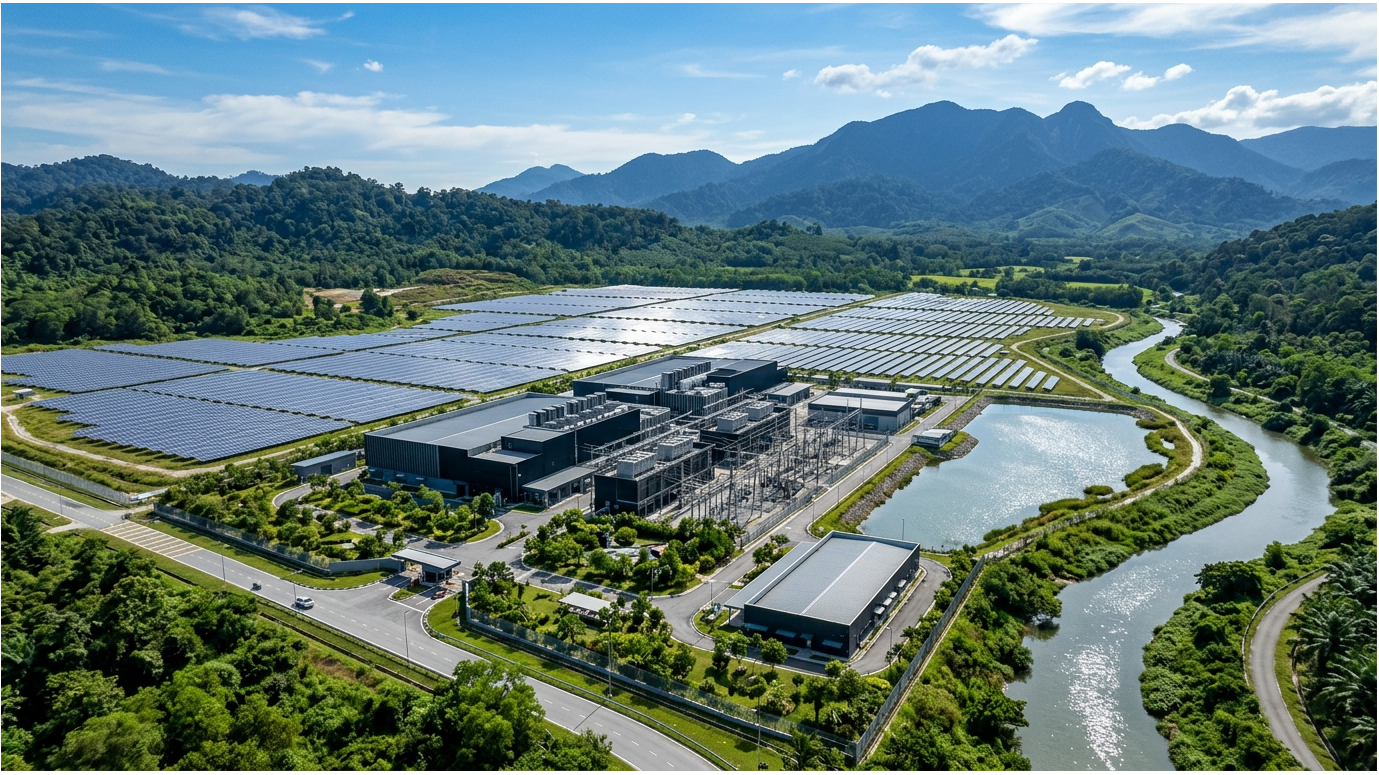
The global race to build artificial intelligence infrastructure is accelerating at an unprecedented pace. Technology giants are committing enormous capital to data centres capable of training and operating increasingly complex AI systems, creating a construction boom that analysts say could reach several trillion dollars in value by the end of the decade.
Yet alongside the excitement surrounding AI’s capabilities, a quieter conversation is emerging among investors and infrastructure planners: how to ensure that these large‑scale facilities remain viable over the long term.
Recent industry discussions highlight a growing concern that location decisions made during periods of rapid expansion can create risks later. In particular, water scarcity, energy constraints and land limitations are becoming critical variables in the economics of AI data centres.
These considerations are beginning to reshape the geography of digital infrastructure development.
In Southeast Asia, Malaysia has positioned itself as a major destination for new data centre investment. Several international operators have already established facilities within the country, attracted by strong connectivity, a stable regulatory framework and proximity to key regional markets.
However, as computing capacity continues to expand, developers are increasingly looking beyond established clusters to locations capable of supporting the next generation of AI workloads.
Tanjong Malim, situated in the northern part of the Klang Valley growth corridor, is emerging as one such location.
The town sits within Perak’s Automotive High Technology Valley, an industrial initiative that has attracted significant investment in electric vehicle manufacturing and advanced engineering. This positioning creates a unique intersection between digital infrastructure and manufacturing innovation.
Within this corridor lies Sungai Samak Estate, a development area that includes five strategically located industrial land plots.
The planning concept behind the estate reflects the changing requirements of AI infrastructure. Rather than focusing solely on the construction of isolated server facilities, the development framework supports integrated campuses capable of hosting data centres, research facilities and advanced manufacturing support operations.
Cooling capacity plays a central role in this design.
High‑density computing environments generate substantial heat, making efficient cooling systems essential. Sites that can draw on reliable water resources — combined with technologies such as recycled cooling water systems — offer significant operational advantages for AI data centre operators.
The Sungai Samak Estate location provides access to natural water sources that can support these requirements while enabling the adoption of more sustainable cooling approaches.
Energy strategy is another defining element.
Many global technology companies have committed to powering future data centres with renewable energy. Locations where on‑site solar generation and hybrid grid integration are feasible are therefore becoming more attractive to developers.
The estate’s land configuration allows for the integration of renewable energy infrastructure alongside digital facilities, supporting a model where computing capacity and energy generation evolve together.
Equally significant is the region’s growing role in the automotive technology sector.
Electric vehicles and autonomous driving systems depend heavily on advanced computing for simulation, battery analytics, and real‑time data processing. As a result, the proximity between AI infrastructure and manufacturing centres can create operational efficiencies.
Sungai Samak Estate’s location near Proton City and other automotive developments positions it within a broader ecosystem where digital infrastructure supports industrial innovation.
Connectivity also remains an important factor.
The region’s access to major transport corridors and network infrastructure provides a foundation for low‑latency data centre operations capable of serving businesses throughout Malaysia and the wider Southeast Asian market.
Taken together, these characteristics illustrate how infrastructure planning is evolving in response to the demands of the AI era. Rather than pursuing scale alone, developers are increasingly prioritising resilience, resource security and integration with real‑world industries.
Additional information about the planning framework and available land plots at Sungai Samak Estate can be found at https://sgsamak.com. Enquiries regarding development opportunities or collaboration can be directed through https://sgsamak.com/contact-us.
As the global AI infrastructure cycle continues to unfold, locations capable of combining digital capacity with sustainable resource management may prove to be among the most strategically valuable assets in the technology landscape.
Sungai Samak Estate
2 Jalan Sempurna off Jalan Gombak
Kuala Lumpur
Federal Territory
53000
Malaysia